
NBA Same-Game Parlays and What UK Books Are Really Selling
 Available in US
- The five-leg ticket I framed as a lesson
- The correlation problem the book solves before you bet
- Why the books advertise them so hard
- The correlation directions that matter
- Leg count and the variance compound
- The boosted SGP and what it actually is
- The hedge potential most bettors miss
- Where SGPs work in a betting portfolio
- The product the books love and the bettors should not
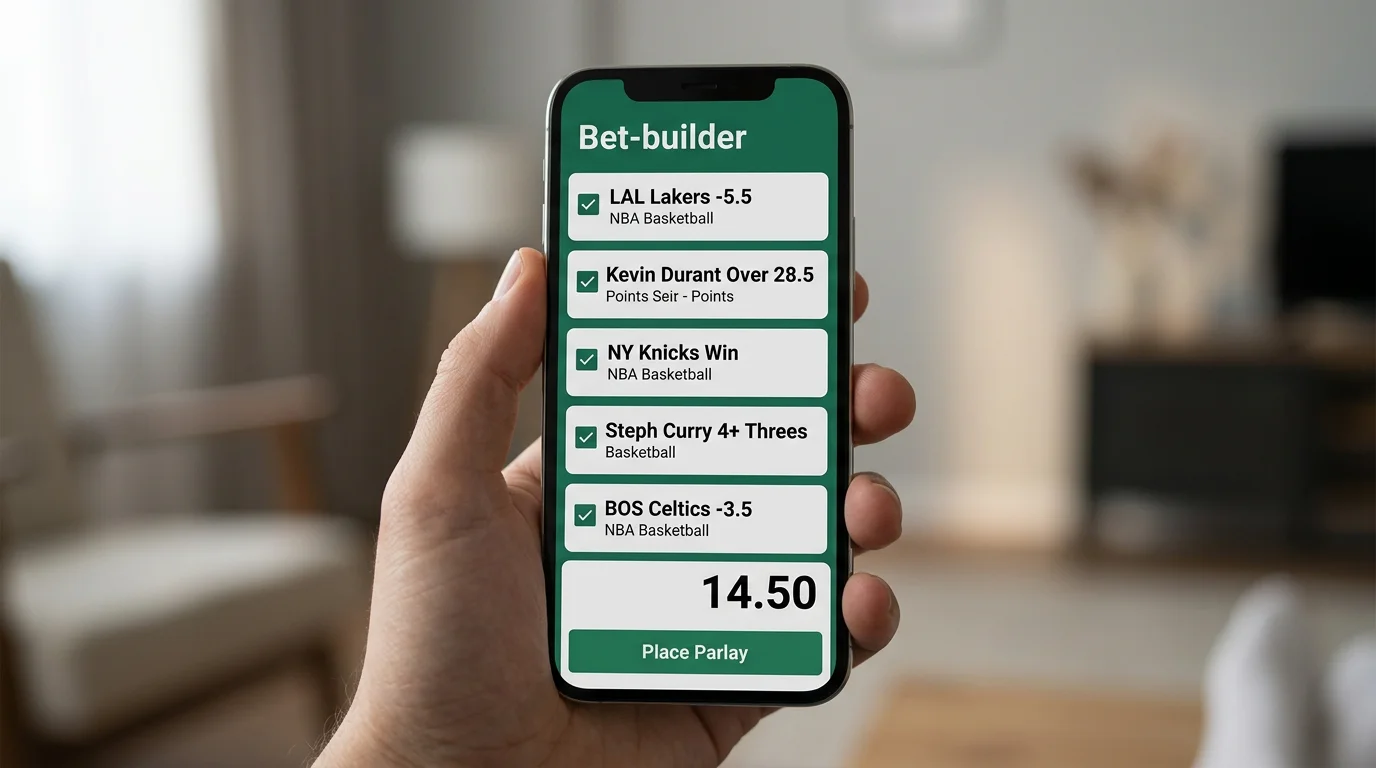
The five-leg ticket I framed as a lesson
There is a screenshot on my phone of a five-leg NBA same-game parlay that paid 47.00. I keep it because it cost me 10 pounds, won me 470, and is the only one of roughly 200 I have placed across a decade that has actually settled. The maths of why is exactly what this market is built around, and once you see it clearly, you will understand why UK books advertise same-game parlays harder than any other product they offer.
A same-game parlay (SGP) – sometimes branded “bet builder” by UK books – is a single ticket combining multiple selections from one game: a spread, a total, a player prop, an outcome, all stacked together. The selections are correlated, the books know it, and the pricing reflects that. The hold on parlays in US industry data hit 24.2 percent in 2025 compared to 4.4 percent on singles, and SGPs sit at the upper end of that range.
The correlation problem the book solves before you bet
If the selections in a parlay are independent – uncorrelated – the parlay price is the product of the individual prices, minus a margin layer. If a 1.91 bet times another 1.91 bet would pay 3.65 ignoring margin, a fair price might be 3.50 with margin. Books that allow independent parlay bets price them this way and the margin is calculable.
Same-game parlays involve selections that are correlated. If you bet a team to win and their star player to score over 25, those two outcomes are not independent – when the star scores big, the team usually wins. The naive parlay maths overstates the price, so books apply a correlation adjustment. They calculate the joint probability, then add their margin, then offer the price.
The problem for the bettor: you cannot see the correlation calculation. The book’s adjustment can be aggressive – much more aggressive than the actual correlation would justify – and the resulting price is opaque. You see 8.00 and have no way to tell whether the fair price was 9.50 or 6.50. The market is one of the few in UK betting where you genuinely cannot reverse-engineer the margin.
Why the books advertise them so hard
The economics are straightforward. A bettor placing five singles at 2.00 each generates roughly 5 percent margin per bet across the singles. The same five selections combined as an SGP generate 20 to 30 percent margin on the combined stake. Same exposure for the bettor, four to six times the margin for the book. The marketing budget reflects this. The promotional offers cluster around SGP products. The default bet slip on most UK mobile apps now treats single bets as the secondary option, with the parlay builder front and centre.
UK gambling industry GGY was 15.6 billion pounds in the year ending March 2025, up 7.7 percent year over year. A meaningful portion of that growth came from the migration of bettors from singles to parlays, driven by mobile UX designed to make parlays the path of least resistance. The product is profitable for the operator and engaging for the bettor. The bettor’s wallet pays the difference.
None of this means SGPs are unbettable. It means the bar for finding value in them is enormously high, and most bettors who think they are good at SGPs are confusing the dopamine of occasional big wins with actual expected value.
The correlation directions that matter
Some correlations in NBA SGPs are obvious: team wins and star scores big, team total over and player points over for that team’s offensive engine, game over and pace-pushing team props all going over. Books typically price these correctly or even over-correct.
Less obvious correlations sometimes get under-priced: a team total under combined with the opposing team’s defensive player getting steals and blocks, a slow-paced game combined with both teams’ star scorers going under their points props, a high-variance prop combined with the team total it pulls in the same direction. Books with sophisticated trading desks catch these. Books with simpler pricing models sometimes miss them.
The work to find SGP value is the work of identifying correlations the book has not priced. This is harder in 2026 than it was three years ago because the trading tools have improved across UK books. The remaining edges are narrow, situational, and disappear quickly when discovered. If you have a real SGP edge, it has a short half-life.
Leg count and the variance compound
Each additional leg added to an SGP multiplies the failure probability. A two-leg parlay with each leg at 70 percent fair probability has a 49 percent chance of hitting. Three legs takes that to 34 percent. Four legs to 24. Five legs to 17. The win rate falls fast and the variance climbs faster.
Bettors anchor to the payout – five legs paying 12.00 sounds great – and ignore that the win rate is 8 percent at the price they actually got. The expected value calculation requires comparing your fair price to the offered price, which is almost impossible to do precisely on SGPs because of the correlation opacity.
My personal rule: no more than three legs. Beyond three, the cumulative correlation adjustments compound to the point where I cannot estimate fair value with any confidence. Two legs is the sweet spot – enough complexity to express a specific opinion, simple enough to evaluate.
The boosted SGP and what it actually is
UK books offer “price boosts” and “enhanced SGPs” promotional features that present a pre-built same-game parlay at an advertised price higher than the standard build. These offers look like value. Sometimes they are. Often they are not.
The pattern: the book identifies an SGP construction with strong correlation (where the legs are heavily linked) and prices it slightly higher than the standard correlated price. The “boost” is real relative to a fully correlated price, but the boost is calculated against an already-discounted starting point. The net result is usually a price that is slightly above the book’s normal hold but still negative expected value relative to truly fair pricing.
Real boosts do exist. When they appear, they are typically promotional rather than algorithmic – the book is taking a loss on a specific marketing offer rather than letting the trading desk price the bet. These are worth taking when you can identify them. The way to identify them is to have a fair-price estimate ready and compare to the boost; if the boost beats your fair price, the bet is on. If you do not have a fair price estimate, you are guessing.
The hedge potential most bettors miss
An SGP that wins its first few legs can be hedged. If you have a five-leg parlay and four legs have settled in your favour with the final leg still pending, you can place a bet on the opposite outcome of that final leg to lock in profit. The maths of this hedge is straightforward: calculate the payout if the parlay wins, calculate the stake needed to guarantee a profit if it loses, place the hedge.
The hedge sacrifices upside. If the parlay wins outright, you give back the hedge stake. If it loses on the final leg, the hedge wins and the locked profit is realised. Whether the hedge is worth taking depends on your bankroll exposure, the size of the locked profit relative to your normal bet size, and your risk tolerance for the binary final outcome.
I hedge SGPs when the locked-in profit is meaningful relative to my normal staking – typically more than 3 units. Below that threshold I let the parlay run free. The same principle applies as in any hedging decision: you sacrifice expected value for certainty, which is sometimes worth it and sometimes not. The pattern echoes what I described in how I structure bet sizing and review my bankroll on a quarterly cycle, where the goal is always preserving the long-term operation rather than maximising a single ticket.
Where SGPs work in a betting portfolio
For most UK NBA bettors, the right SGP allocation is small or zero. The combination of opaque pricing, structural margin disadvantage, and behavioural temptation to build longer tickets than the maths supports means SGPs are net negative for the typical bettor. The 47.00 winner I framed is the exception that confirms the pattern – one big win across 200 attempts does not validate the market, it just makes the losing pattern visible only in retrospect.
Where SGPs earn a place: small entertainment allocations sized as a separate sub-bankroll, occasional bets when a specific correlation appears mispriced, promotional offers with calculable value advantage. These are exceptions to the general rule, not the foundation of a profitable operation.
The bettor who builds their week around SGPs is fighting structural margins of 20 to 30 percent. No amount of handicapping skill overcomes that math over a long sample. The handicapping skill becomes valuable in singles, where the margins are 4 to 5 percent and the edge work can outpace the vig. SGPs are a different game with different odds against, and treating them like singles is the most expensive mistake in NBA betting.
The product the books love and the bettors should not
UK books offer SGPs on every NBA game, with promotional pushes most nights, and the volume keeps growing. The product is here to stay, and avoiding it entirely is a reasonable strategy. So is using it surgically, with strict leg limits and an awareness of the correlation games being played in the pricing.
What does not work: building five-leg parlays nightly, treating the occasional winner as evidence of skill, and ignoring the long sample of losses that produce the book’s margin. That pattern is exactly what the SGP product is designed to encourage, and the encouragement is effective. The framed screenshot on my phone is a souvenir of the structure, not a refutation of it. Most weeks the structure wins. The right question is not “can I beat SGPs” – sometimes you can – but “is the expected value of trying better than the alternative use of the same bankroll.” Almost always, the answer is no.
What is the typical hold on an NBA same-game parlay?
At UK books, between 15 and 25 percent on standard SGP constructions, compared to 4 to 5 percent on singles. The exact figure depends on leg count and the correlation adjustments the book applies, which are usually opaque.
How many legs should an SGP contain to be worth betting?
In my experience, no more than three. Beyond three legs, the compounding correlation adjustments become too opaque to estimate fair value, and the variance overwhelms even strong individual handicapping.
Are boosted SGP promotional offers genuinely good value?
Sometimes – when the boost is promotional rather than algorithmic. You need a fair-price estimate to know which it is. Without that estimate, you are betting blind and the structural odds favour the book.
Written by the editors at nba bet of the day.