Illegal Black-Market NBA Betting Dangers for UK Punters
 Available in US
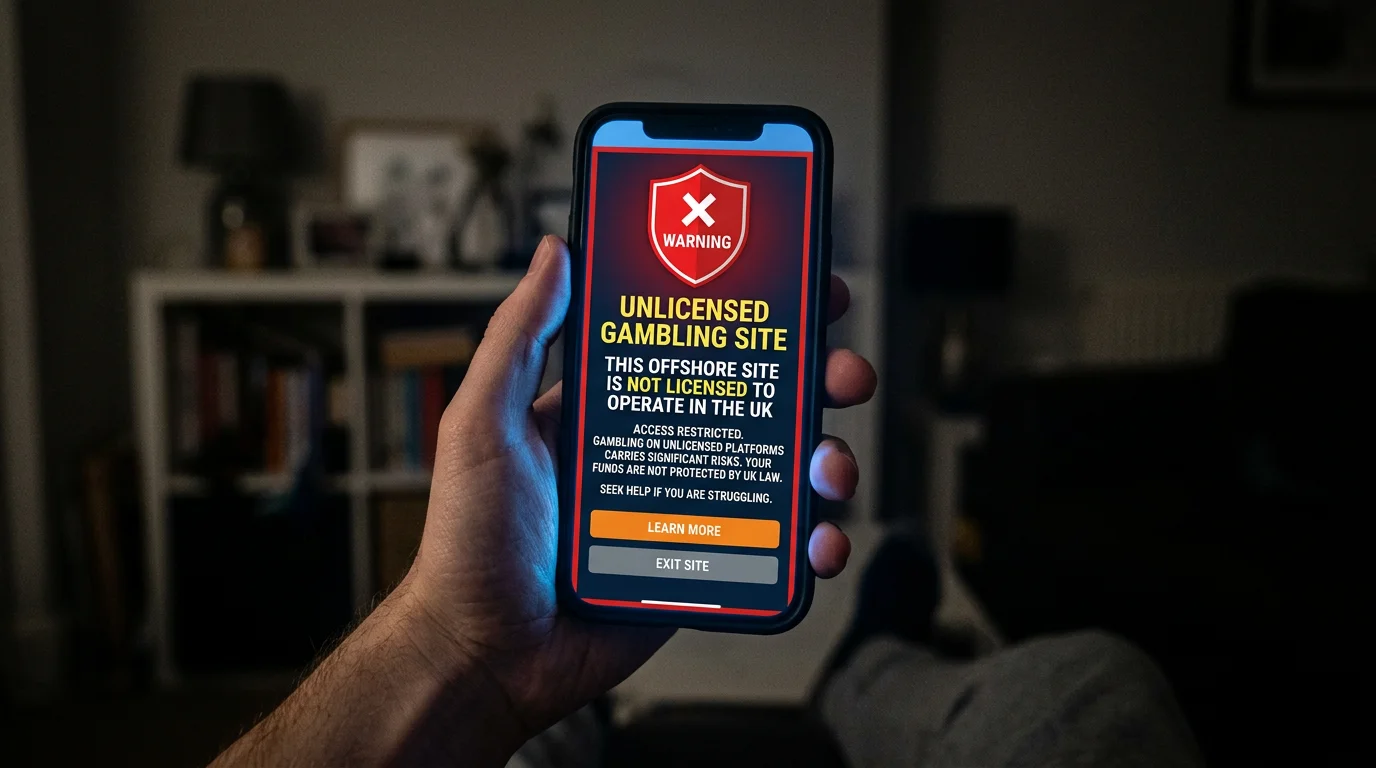
Payout Disputes: Legal and Financial Vulnerabilities at Unlicensed Offshore Sites
In early 2024, a friend of mine – a smart, financially literate friend with a finance job – moved his NBA action to an offshore book that had been advertising aggressively on a betting Telegram group. The pitch was textbook: no stake limits, better lines on player props, no KYC delays. He ran a strong winter through the regular season, finished with £4,200 in his balance, and tried to withdraw on the morning of the playoffs. The withdrawal sat pending for nine days. On day ten, the support chat stopped responding. By the end of the month, the site was gone.
He had no UKGC route. No IBAS arbitration. No legal claim worth pursuing in whichever Caribbean jurisdiction the operator had been notionally licensed in. His £4,200 was gone in the same sense that money you light on fire is gone. He still bets, but he bets exclusively at UKGC books now, and he tells the story to anyone who’ll listen. I’m telling it to you.
The scale of the UK black market is bigger than people think
H2 Gambling Capital, the analytics outfit whose figures the regulated industry uses for sizing exercises, estimated the UK unlicensed gambling market at £16.6 billion in 2025. That’s against roughly £5 billion in 2019, which is the kind of growth curve that only makes sense if you understand what’s been pushing punters out of the regulated estate and into the dark corners.
Three things have been pushing. First, affordability checks on the regulated side have become more intrusive – operators are required to ask for source-of-funds documentation at thresholds that catch a meaningful slice of recreational punters. Second, account restrictions on profitable customers have become aggressive enough that any half-decent line shopper ends up with their main accounts capped. Third, the marketing on the offshore side – Telegram, Discord, sponsored crypto Twitter – has become slicker and more targeted than ever. The combination drives the migration.
For NBA specifically, the unlicensed market attracts two distinct customer profiles. The casual high-volume bettor who hates KYC and wants to play with crypto sits on one end. The semi-professional who has been restricted across every domestic book sits on the other. Both face the same risk: when the bookmaker decides not to pay, there is no recovery mechanism. The £16.6 billion figure is staggering on its own; the £500 million in additional yield the Office for Budget Responsibility expects to leak offshore following the increase of Remote Gaming Duty to 40 percent tells you the regulator anticipates the migration continues. The Treasury has earmarked £26 million for the Gambling Commission specifically to combat the unlicensed sector – a fight that’s now actively resourced, not just talked about.
Why offshore books pull UK NBA punters
I want to be honest about this. Offshore books aren’t attractive purely because UK punters are reckless. They’re attractive because they offer real things UKGC-licensed books don’t, and pretending otherwise insults the intelligence of anyone reading.
The offshore appeal usually comes down to four levers. Higher stake limits – particularly on NBA player props, where domestic books cap individual prop stakes at £20 to £200 routinely. Sharper lines – some offshore operators are explicitly reduced-juice books, taking 2 to 3 percent margins versus the 5 percent typical at major UK retail-led brands. Faster onboarding – no source-of-funds, no occupation verification, no document uploads. And resistance to restriction – many offshore books simply don’t restrict winning customers, on the basis that they prefer the volume and price you out through the line itself.
Each of those features is real. None of them is free. You’re paying for them with the absence of consumer protection, and the price doesn’t show up until the moment you need the protection. By that point it’s too late. The trade is asymmetric – you get marginal upside on every winning bet and catastrophic downside on the rare withdrawal failure or dispute. That’s the wrong shape of bet, and it’s the shape almost every offshore experience eventually takes.
The tangible risks when payouts go wrong
Let me describe the specific failure modes I’ve seen, because “offshore is risky” is too abstract to do anything with.
The first and most common failure is the slow payout death. The site doesn’t say no – it just stops processing. Your withdrawal sits pending for two weeks. Support sends auto-replies. A new verification request appears. You upload the documents. They get rejected for ambiguous reasons. You upload them again. Eventually the site either pays you to make you go away, or it doesn’t, and you eventually accept that the money is gone. There is no third party to compel resolution.
The second failure is the rule reinterpretation. A bet you placed at -110 settles at -120 because the bookmaker decides retroactively that the published line was a typographical error. A prop that should have paid voids because the bookmaker introduces a “minimum minutes played” clause that wasn’t in the rulebook when you struck the bet. With no IBAS access, you have nothing to escalate to. The bookmaker’s rules are whatever the bookmaker says they are this week.
The third failure is the platform collapse. The site goes dark overnight. Customer balances vanish with it. The corporate entity registered in Curacao or Costa Rica simply ceases to file paperwork. For UK customers with no jurisdictional ground to stand on, civil action is functionally impossible. I’ve seen estimates of recovery rates in the single digits, and those are generous.
The fourth failure is the data leak. Offshore books have, statistically, weaker security and lower regulatory pressure to disclose breaches. Your KYC documents – if you uploaded any – your card numbers, your IP history end up on a forum somewhere. UK GDPR offers you essentially no recourse against a Curacao-registered entity that’s already gone dark.
The fifth, and the one that catches more punters than anyone admits: the bet that wins so much the bookmaker simply confiscates it. Offshore terms routinely include sweeping anti-arbitrage and bonus-abuse clauses that can be invoked retroactively against any large winning balance. A UKGC operator does the same thing only at far smaller scale, and the UKGC framework requires that confiscation decisions be subject to dispute resolution. Offshore, the only resolution is whatever the bookmaker decides.
What changes with Remote Gaming Duty at 40 percent
The Treasury’s increase of Remote Gaming Duty to 40 percent – formalised through 2025 and into 2026 – has materially shifted the economics on the regulated side, which means the offshore comparison sharpens. I want to walk through what that actually changes for the UK NBA punter.
On the regulated side, operators absorb part of the duty hike and pass part of it on. The pass-through shows up as worse lines, smaller boost offers, tighter promotional terms, and increased account restrictions on price-sensitive customers. None of that is good news for UK punters. It is, however, the cost of operating within a framework that gives you legal recourse, segregated funds, and IBAS arbitration.
On the offshore side, the duty hike makes the price gap visible. An offshore book paying no UK tax and running a 2.5 percent margin can offer NBA spreads at 1.95 against the UK consensus of 1.91 without breaking sweat. That four-basis-point gap is real money over volume. The temptation to migrate increases mechanically with every duty point added.
The OBR’s £500 million leakage estimate reflects exactly this dynamic, and the £26 million enforcement allocation tells you the regulator’s response. What that means in practice for the UK punter: expect more disruption to offshore payment routes, more deposit blocks at UK banks for known-unlicensed operators, more high-profile prosecutions of the marketers who push UK customers offshore. The black market doesn’t go away – the £16.6 billion number tells you that – but the cost of accessing it rises.
None of this changes the calculus on the worst-case scenario. When the bookmaker doesn’t pay, the UKGC licensee has a regulator that can compel action, and the offshore operator has nothing of the kind. Whatever the price improvement on individual lines, the asymmetric risk on the bankroll-shaped event of a payout failure makes the offshore route a bet I cannot recommend at any stake size. The other side of the same regulatory coin – what the licensing actually buys you – is something I unpack in detail in my breakdown of UK gambling advertising rules and how they shape NBA betting sites.
What happens to my pending NBA bet if an offshore book vanishes overnight?
In practical terms, the bet and the balance go to zero. Your only recovery route is a civil claim in the jurisdiction where the operator is registered – typically Curacao, Costa Rica, or another offshore licensing centre – and the cost of pursuing such a claim almost always exceeds the balance lost. There is no UKGC complaint pathway, no IBAS arbitration, no segregated-funds claim. UK banks and card networks have begun blocking transactions to known unlicensed operators, which reduces deposit volume but doesn’t help anyone whose money is already on the platform when it folds.
How does the 40% Remote Gaming Duty change the UK NBA market for 2026?
Regulated UK operators absorb part of the duty hike and pass part of it through to customers as worse lines and tighter promotional terms. The Office for Budget Responsibility expects up to £500 million of yield to leak to the unlicensed market as a direct result, which is why the Treasury allocated an additional £26 million to the Gambling Commission for enforcement. For the UK NBA punter, the practical effect is that the price gap between regulated and offshore widens, the temptation to migrate increases, and the regulator’s response gets more visible and more aggressive.
Created by the ”nba bet of the day” editorial team.