Implied Probability Calculations for Decimal NBA Odds
 Available in US
Conversion Math: Stripping Vig to Establish Fair NBA Probability Lines
For my first eighteen months of betting NBA, I thought I understood odds. I could read them, compare them, and convert formats. What I couldn’t do was answer a deceptively simple question – does the bookmaker think this team wins more than half the time, or less? I’d stare at Lakers -130 and feel an opinion form, but I had no way to test that opinion against the price.
The fix arrived at a dinner with a former trader from a UK book. He drew a single formula on a napkin: one divided by the decimal odds. That number, he said, is what the bookmaker thinks the chances are – sort of. The “sort of” turned out to be the entire game, because the bookmaker’s number includes their margin. Strip the margin away and you have what the market actually thinks. Strip it away on both sides of a two-way bet and you have something even more useful: a no-vig fair line you can compare your own model to. That napkin reset how I bet.
The formula from decimal odds and what it gives you
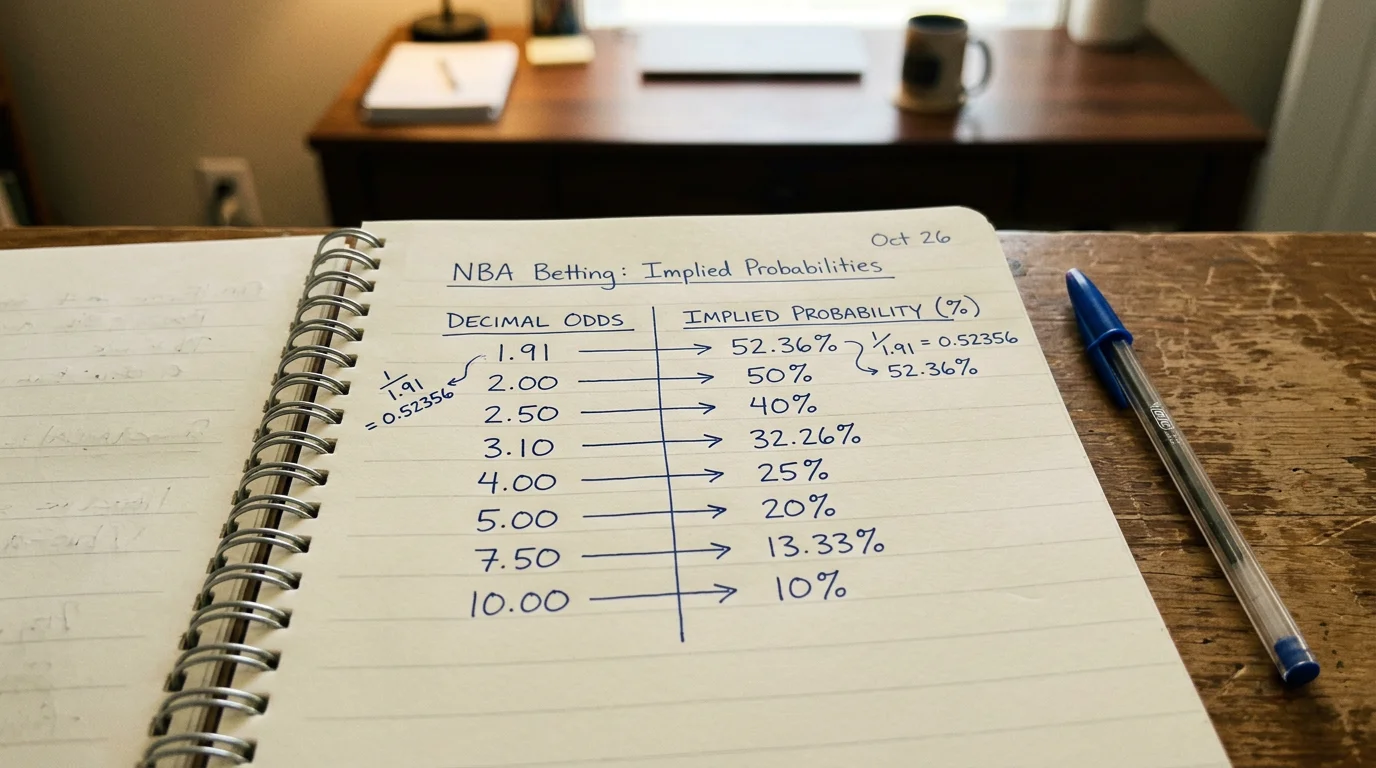
Implied probability from decimal odds is the cleanest equation in betting maths. Take one. Divide it by the decimal price. Multiply by 100 if you want it as a percentage.
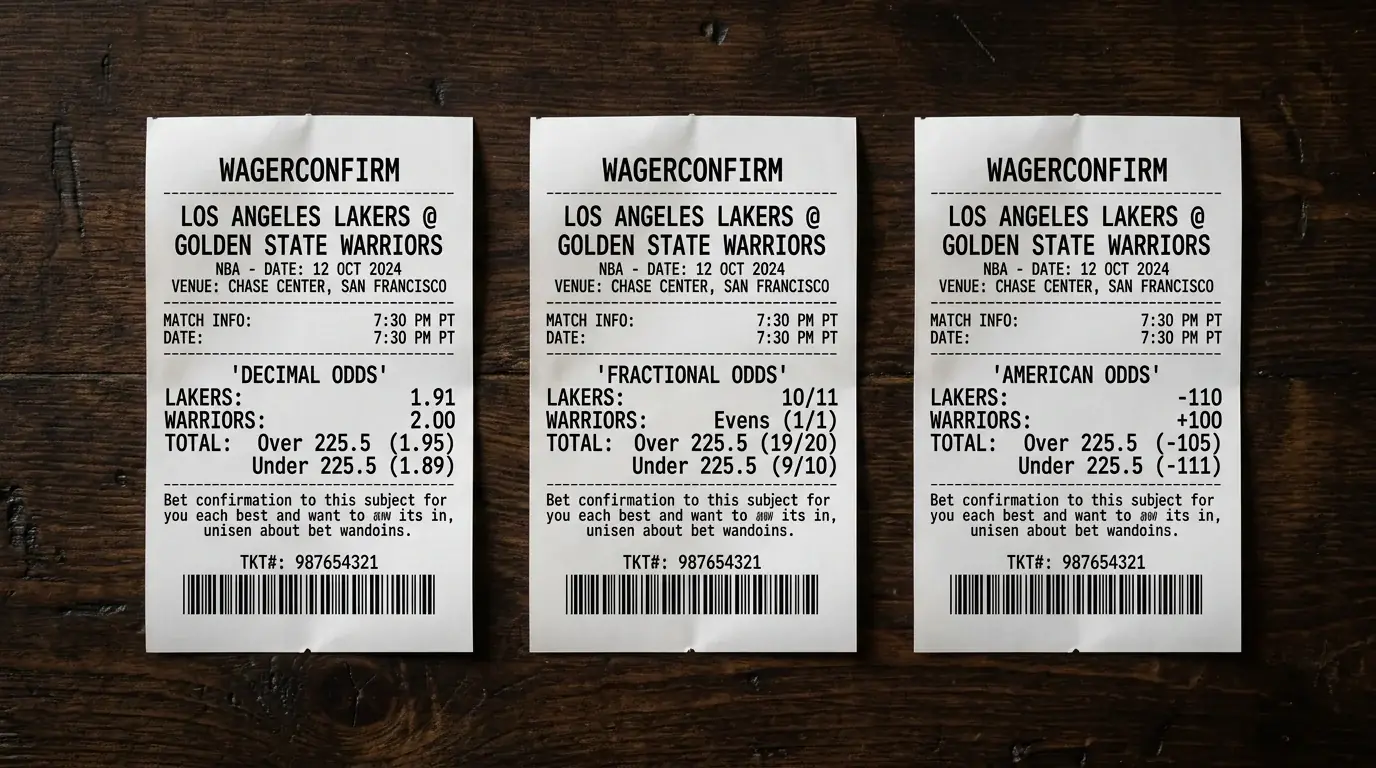
1 ÷ 1.91 = 0.5236, which is 52.36 percent.
1 ÷ 2.00 = 0.5000, which is 50 percent.
1 ÷ 2.50 = 0.4000, which is 40 percent.
1 ÷ 5.00 = 0.2000, which is 20 percent.
That percentage is the bookmaker’s break-even point for the bet. If the true probability of the outcome is higher than the implied probability, the bet has positive expected value over enough trials. If the true probability is lower, the bet has negative expected value. Every other piece of strategy in betting builds on top of this comparison.
The reason this works specifically from decimal odds is that decimal is a direct expression of the return. The decimal already tells you the multiplier on your stake including the stake back. Dividing one by that multiplier gives you the win probability that exactly breaks even at the offered price. You can do the same arithmetic from fractional or American odds, but you have to route through more steps – for fractional, the formula is denominator divided by sum of numerator and denominator; for American, you split at zero into two formulas. Decimal collapses all of it into one operation, which is why every serious bettor I know works in decimal.
One nuance most beginners miss. The implied probability you calculate is the bookmaker’s number, not the market’s true number. The bookmaker has built a margin into the price – usually 4 to 6 percent on UK NBA mainlines – which means the implied probabilities across all outcomes of a market sum to more than 100 percent. That excess is the overround, and you need to remove it before you can compare your model to the underlying market.
How the bookmaker juices the market
Bookmakers don’t take fair-coin bets. They take bets where both sides of a 50/50 are priced as if they’re slightly less than 50/50. The classic NBA spread example: Lakers -3.5 at 1.91, Bucks +3.5 at 1.91. Implied probability on each side is 52.36 percent. Sum is 104.71 percent. The 4.71 percent above 100 is the bookmaker’s theoretical hold on a perfectly balanced book – what the industry calls the overround or vig.
Across the US market in 2025, sportsbook hold averaged 10.15 percent across all products – meaning of every $100 in handle, the books retained $10.15 – though that figure blends single bets with parlays, which are a different beast. Single-bet hold runs much closer to the 4 to 6 percent NBA mainline number. Parlay hold runs as high as 24.2 percent, against just 4.4 percent on singles. That’s why books push acca product so aggressively, and it’s why a punter who understands implied probability will look at a five-leg same-game parlay quoted at +800 with deep suspicion: the implied probability is 11.11 percent, but the no-vig fair probability is comfortably under 9 percent on most builds.
The point of stripping the vig isn’t moral outrage at the bookmaker. The point is that you cannot evaluate your model against the bookmaker’s number – you can only evaluate it against the bookmaker’s number minus the margin. That’s the no-vig fair line, and computing it is mechanical.
Calculating the no-vig fair line on an NBA two-way market
This is the workhorse calculation. Most NBA mainline markets are two-way – spread, moneyline, total – and the no-vig calculation works the same way for all three.
Take the implied probabilities of both sides. Sum them. Divide each by the sum. The result is each side’s share of the total probability, scaled back to 100 percent. That’s the no-vig fair probability for each outcome.
Worked example, with the Lakers -3.5 at 1.91 and Bucks +3.5 at 1.91 I used earlier.
Lakers implied: 1 ÷ 1.91 = 0.5236.
Bucks implied: 1 ÷ 1.91 = 0.5236.
Sum: 1.0471.
Lakers no-vig fair: 0.5236 ÷ 1.0471 = 0.5000.
Bucks no-vig fair: 0.5236 ÷ 1.0471 = 0.5000.
The bookmaker’s pricing is symmetric – the market thinks the line is exactly correct, with each side at true 50 percent. That’s what you’d expect from a sharp NBA spread shortly before tip-off, when the line has been honed.
An asymmetric example. Suppose the moneyline is Heat 1.50 versus Knicks 2.65.
Heat implied: 1 ÷ 1.50 = 0.6667.
Knicks implied: 1 ÷ 2.65 = 0.3774.
Sum: 1.0440.
Heat no-vig fair: 0.6667 ÷ 1.0440 = 0.6386.
Knicks no-vig fair: 0.3774 ÷ 1.0440 = 0.3614.
The market’s true assessment is that the Heat win 63.86 percent of the time. If your own model puts the Heat at 67 percent, you have a 3.14 percent edge, and the bet has positive expected value at the offered price. If your model puts the Heat at 60 percent, you don’t – the bookmaker is offering a price you should fade rather than back.
The same logic extends to three-way markets, four-way markets, and so on, with one important caveat: the longer the tail of outcomes, the larger the overround tends to be, and the more sensitive the no-vig calculation becomes to small pricing errors at the long end. For NBA, you’ll mostly be running two-way calculations on mainlines and props, and the routine becomes second nature within a few weeks of doing it.
Applying implied probability to tonight’s slate
The mechanics are the easy part. The harder part is knowing what to do with the no-vig number once you have it.
My workflow for any NBA slate looks like this. Pull the consensus closing line from a couple of sharp UK books on every game I have an opinion on. Compute the no-vig fair probability for both sides of each mainline. Compare those to my own probability estimate – either from a model I trust, a hand-built breakdown, or, honestly, a gut number adjusted for known biases. Bet only the games where my number diverges from the no-vig number by enough to clear the margin I’m paying at the actual offered price.
The “enough to clear” threshold is critical. If you bet every game where your estimate is one percent higher than the no-vig fair, you’re betting essentially at break-even before factoring noise in your own estimates. A reasonable starting threshold for a recreational punter is 3 to 4 percent of edge over no-vig, scaling up as you develop confidence in your own probability assessments. Sharp professional bettors operate at thinner edges because they trust their models, and because they’ve reduced the bookmaker’s margin further through line shopping across multiple books.
One detail that surprises people new to the calculation. The no-vig probability is what the market thinks, not what is objectively true. The market is usually right – closing lines are extremely efficient at the NBA mainline level, which is why beating the closing line consistently is the single best long-term predictor of profitable betting. Implied probability and the no-vig calculation are the language you use to have that conversation with the market. They don’t tell you who wins. They tell you what you’re being paid for being right, and that’s the only number that matters when you’re sizing a bet. From here, the natural next step is making the vig itself visible across formats and markets, which is exactly what I cover in my deep dive on NBA vig and juice for UK punters.
How do I strip the vig out of a two-way NBA moneyline to find the fair probability?
Convert both sides of the moneyline into implied probabilities using one divided by the decimal price. Add the two implied probabilities together – the sum will be over 100 percent, with the excess being the bookmaker’s overround. Divide each implied probability by that sum. The result is each side’s no-vig fair probability, scaled back to a total of 100 percent. That fair probability is the market’s true assessment of the outcome, stripped of margin, and it’s the number you compare your own model to when deciding whether the price offers positive expected value.
Why don’t the two implied probabilities on an NBA spread add up to 100%?
Because the bookmaker has built a margin into both sides of the price. A typical UK NBA mainline spread of 1.91 against 1.91 gives implied probabilities of 52.36 percent on each side, which sum to 104.71 percent. The 4.71 percent above 100 is the bookmaker’s overround – the theoretical hold on a perfectly balanced book. Removing that overround through the no-vig calculation gives you the market’s true symmetric probability assessment, which on a sharp closing spread is essentially 50/50 on either side of the handicap.
Written by the editors at nba bet of the day.