Calculating NBA Vig and Bookmaker Margins in the UK
 Available in US
Overround Calculations: Exposing Baked-in Bookmaker Margins on Lines
I spent most of 2014 and 2015 furious that I couldn’t beat NBA spread betting consistently. I had a working model. I had clear opinions. I was beating the market by my own assessment maybe 53 percent of the time. I should have been profitable. I wasn’t. The math wasn’t mathing, as my teenage daughter would say.
The answer turned out to be embarrassingly simple. I needed to win not 50 percent to break even – I needed to win 52.38 percent, because the bookmaker had baked their margin into the price. My 53 percent was a wafer above break-even, not the genuinely profitable rate I’d been telling myself it was. From that point on, I treated the bookmaker’s margin as a tax I had to subtract from every result, and the picture changed completely.
Vig, overround, margin: same thing, three names, one cost
The terminology is unnecessarily confusing because three industries that used to overlap have each named the concept differently. Vigorish – usually shortened to vig – is the American term, originally from the Russian word for “winnings” via Yiddish. Juice is the colloquial US bettor term for the same thing. Overround is the British bookmaker term. Margin is what the trading desk calls it internally.
All four describe the percentage by which the implied probabilities across a market sum to more than 100 percent. They are the same number, with the same calculation underneath. Pick one and stick with it – I use vig in conversation and overround in writing because British readers understand both, but the choice is purely stylistic.
The standard NBA mainline spread comes in at 1.91 against 1.91 – implied probabilities of 52.36 percent on each side, summing to 104.72 percent. The 4.72 percent excess is the bookmaker’s theoretical hold on a perfectly balanced book. In practice, bookmakers don’t balance their books perfectly, and their actual realised hold can be higher or lower depending on which side has taken more action. Across the US market in 2025, sportsbook hold averaged 10.15 percent across all products – but that figure is heavily inflated by parlay activity, which holds at far higher rates than singles.
Calculating the margin on any decimal-priced market
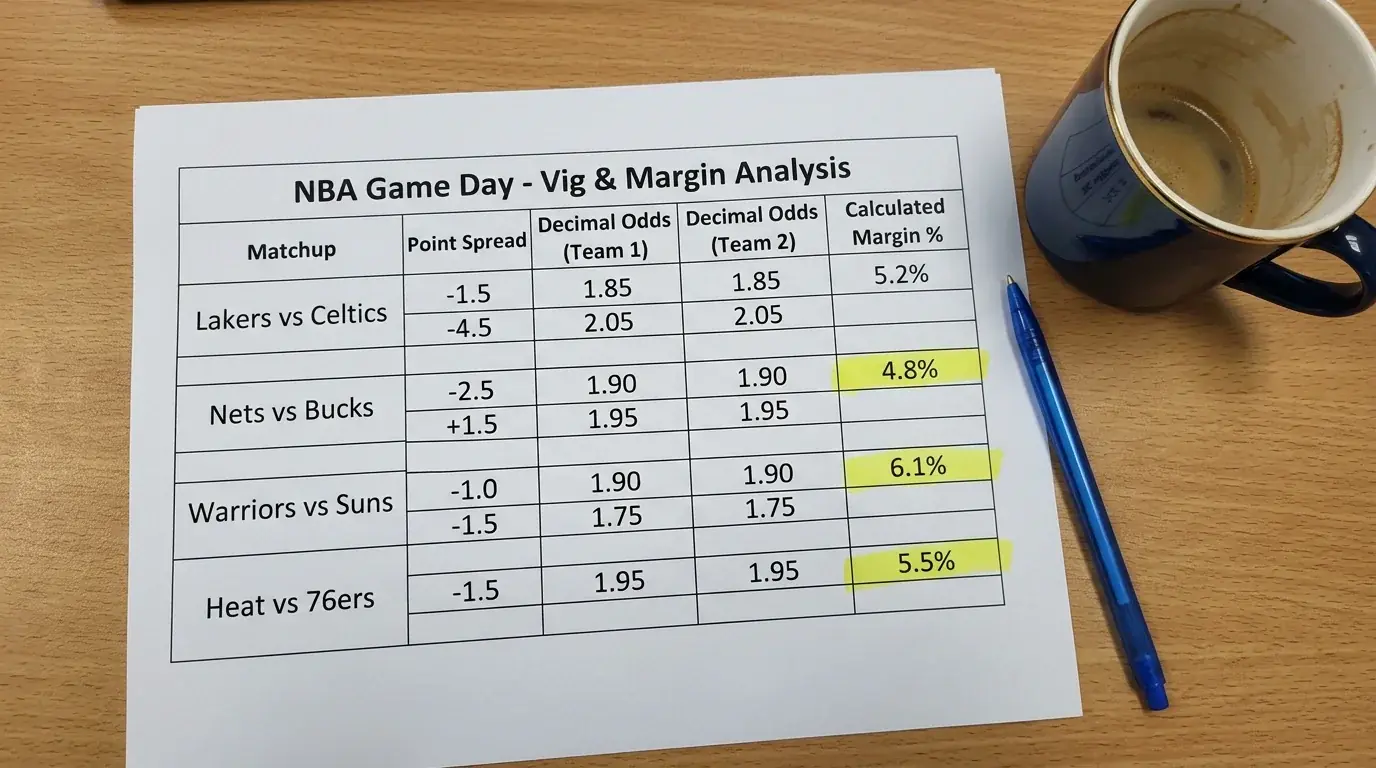
The mechanics are simple enough that you can do them in your head once you’ve practised a few times. For a two-way market, the margin is the sum of the two implied probabilities minus 100 percent. For a three-way or longer market, the margin is the sum of all implied probabilities minus 100 percent.
Two-way example, the simplest case. Lakers 1.91, Bucks 1.91.
Implied Lakers: 1 ÷ 1.91 = 0.5236.
Implied Bucks: 1 ÷ 1.91 = 0.5236.
Sum: 1.0472. Margin: 4.72 percent.
Asymmetric two-way example. Heat 1.50, Knicks 2.65.
Implied Heat: 1 ÷ 1.50 = 0.6667.
Implied Knicks: 1 ÷ 2.65 = 0.3774.
Sum: 1.0440. Margin: 4.40 percent.
Two-way prop with wider margin. Player rebounds over 8.5 at 1.85, under 8.5 at 1.85.
Implied over: 1 ÷ 1.85 = 0.5405.
Implied under: 1 ÷ 1.85 = 0.5405.
Sum: 1.0811. Margin: 8.11 percent.
That last example shows the practical truth about NBA betting: the margin on props is meaningfully fatter than the margin on mainlines. The further you wander from the most-bet, most-arbitraged markets, the more the bookmaker’s margin protects them. A punter who refuses to compute the overround on every market they bet is, in effect, accepting an invisible cost that varies wildly between products without ever knowing what they’re paying.
One quick mental shortcut. The break-even win rate at any price equals the implied probability of that price. At 1.91 you need 52.36 percent winners. At 2.00 you need 50 percent. At 1.83 you need 54.64 percent. If you can recall those three anchor points, you can size up any spread or moneyline in seconds without reaching for a calculator.
Low-juice and reduced-vig promotional offers
Some UK books periodically run reduced-vig promotions on NBA mainlines, advertising prices like 2.00 against 2.00 instead of the standard 1.91 against 1.91. The marketing typically frames these as “best price guarantee” or “vig-free Sunday” or similar. The headline number looks generous because it is – at 2.00 against 2.00, the implied probabilities sum to exactly 100 percent, which is no margin at all on a perfectly balanced book.
The catch is twofold. First, no major UK book runs these offers continuously – they’re typically limited to specific games, specific markets, or specific account segments. Second, the books offering them are also the books most aggressive about restricting customers whose betting patterns suggest they’ll continue to profit from the lower-margin pricing. Reduced-juice promos are loss-leaders to acquire customers, and the bookmakers expect to recover the cost from those customers’ less price-sensitive betting at higher-margin product later.
None of that makes the offers bad – quite the opposite. If you’re a recreational punter who’d be playing the game anyway, betting reduced-vig markets when they’re available is unambiguously better than betting standard-vig versions of the same game. The strategic question is whether you can take advantage of the offers without triggering the restrictions that follow. The honest answer is: probably not, if you bet enough volume to matter. The reduced-vig markets are where books identify the sharpest customers fastest.
Why prop vig sits so much higher than mainline vig
Props are the area where overround pricing diverges most dramatically from the mainline. A standard NBA spread carries 4 to 5 percent margin. A standard NBA player prop frequently carries 8 to 10 percent. On low-volume rebound or assists markets for fringe rotation players, I’ve seen overround push past 15 percent at major UK books.
Three structural reasons explain the gap. First, prop volume is lower than mainline volume, so the bookmaker has less crowd-sourced pricing signal to refine the line. The fewer informed bets coming in, the more cautious the trader has to be, which means a fatter spread. Second, props are more vulnerable to information asymmetry – a punter who knows a player’s been at practice late might genuinely have more information than the bookmaker’s projection model, particularly for non-stars. Third, props have a longer tail of possible outcomes than a two-way moneyline, and that tail is hard to price accurately, so the bookmaker prices conservatively to insulate against the worst-case scenarios.
The 2025 NBA gambling integrity case involving Terry Rozier and Chauncey Billups added a fourth factor. Adam Silver explicitly stated in late 2025 that the league had asked some of its partner sportsbooks to pull back specific prop bets, “especially when they’re on two-way players – guys who don’t have the same stake in the competition – where it’s too easy to manipulate something that seems small and inconsequential.” UK books followed the US lead and trimmed their two-way-player prop offerings. The result is that the props that remain post-Rozier carry even fatter margin than they did before, because liquidity has consolidated into a narrower set of markets that the books price more cautiously for the increased reputational risk.
The practical implication for UK punters is that prop betting needs to clear a higher EV bar than mainline betting to be worth the bankroll. You’re paying double the margin, sometimes triple, and your edge has to be commensurately larger. I cover this in much more detail in my breakdown of NBA prop bet vig and margins at UK bookmakers, including the alternate-line mechanics that occasionally let you redistribute that margin in the punter’s favour.
Why is the vig on NBA player props higher than on moneylines at UK books?
Three reasons stack on top of each other. Props have lower betting volume, so the bookmaker has less crowd-sourced pricing signal to refine the line and must price conservatively to insulate against errors. Props are more vulnerable to asymmetric information – a punter following practice reports, beat-writer Twitter or rotation news can occasionally have a real edge the model hasn’t caught. And props have a longer tail of plausible outcomes than a two-way moneyline, with the tail risk that single events drag the result outside any reasonable projection. Combined, those factors push the typical NBA prop overround into 8-10 percent territory.
Are ‘reduced juice’ promotions in the UK ever a long-term winning angle?
They are a real benefit for as long as you can access them. Reduced-juice NBA mainlines, sometimes marketed as ‘best price guarantee’ or ‘vig-free’ specials, offer a genuinely better expected value than the standard 1.91 against 1.91 mainline. The structural limitation is that books offering these markets actively identify and restrict the customers who profit from them – the offers are designed as acquisition tools, not as sustainable margin policy. Recreational punters can benefit while they last; volume punters tend to get stake-capped fairly quickly.
Published by the nba bet of the day team.