NBA Arbitrage Across UK Bookmakers and the Realities of the Strategy
 Available in US
- The strategy that sounds too good and partly is
- The maths that determines whether the spot is real
- Why arbitrage exists at all
- The operational friction nobody mentions
- The account-restriction problem
- The promotional arb that books mostly tolerate
- The margin of error that ruins beginners
- The maths of small edges compounding
- The honest assessment
The strategy that sounds too good and partly is
When I first read about arbitrage betting, the maths made it sound like free money. Bet both sides of an NBA market at two different UK books, capture a small guaranteed profit regardless of outcome, repeat hundreds of times across a season. The reality is more complicated, the profits are smaller than the theory suggests, and the operational friction is much higher than most explainers acknowledge. Arbitrage exists in NBA betting and it can produce returns, but the version that survives contact with real UK books looks different from the version described in betting forums.
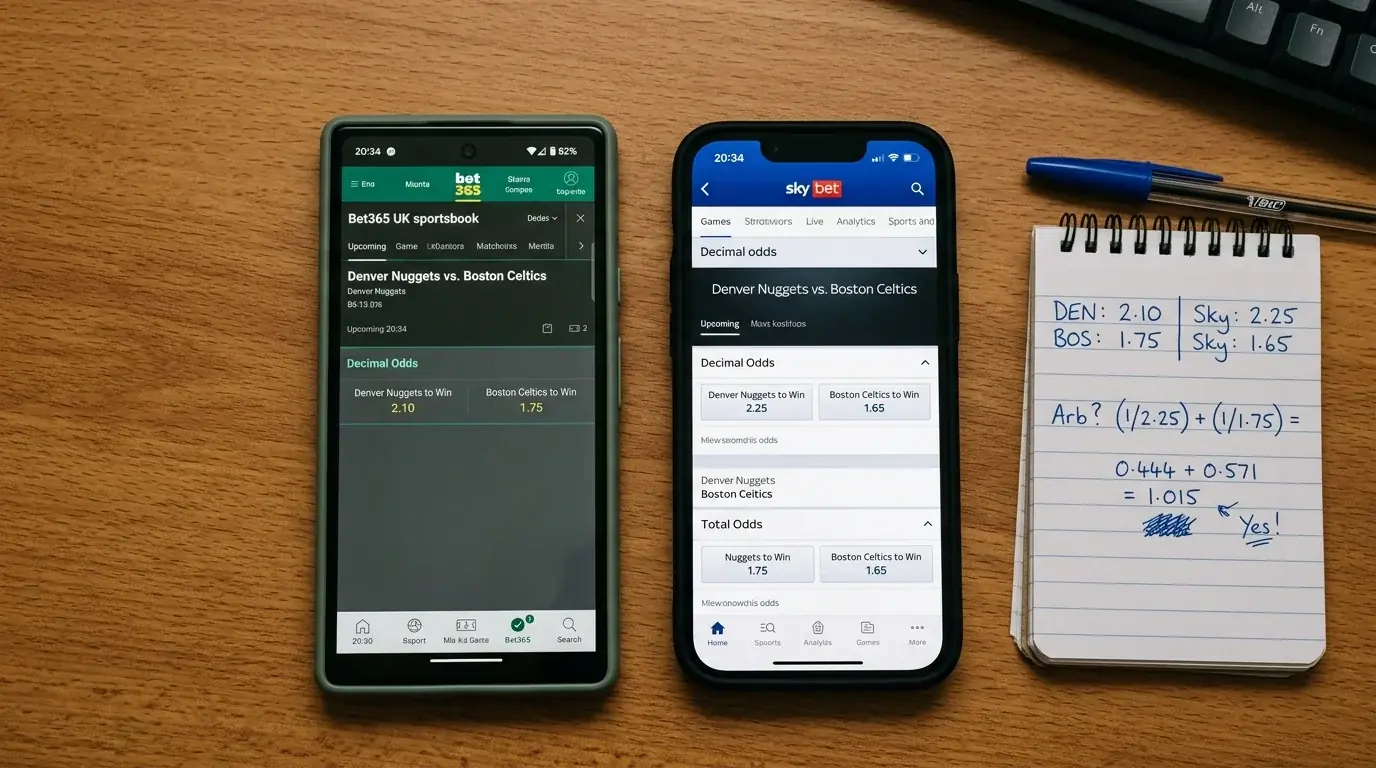
An arbitrage opportunity occurs when prices at two different operators allow a bettor to back both sides of a binary market and profit regardless of which side wins. If Book A has Team X at 2.10 and Book B has Team Y at 2.10, the combined implied probability is 95.2 percent – less than 100 percent – and the difference is the bettor’s guaranteed return.
The maths that determines whether the spot is real
The formula is straightforward: for a two-way market, add the inverse of each decimal odd. If the sum is less than 1, you have an arbitrage opportunity. The amount below 1 is your guaranteed return on combined stake.
Team X at 2.10 has implied probability 0.476. Team Y at 2.10 has implied probability 0.476. Total: 0.952. The arbitrage profit is 1 minus 0.952, which is 4.8 percent on combined stake. Bet 1000 pounds total across the two sides in the correct proportions, and you walk away with 1048 regardless of which team wins.
The proportional split: stake on each side is proportional to the implied probability of the other side. Stake on Team X at 2.10 is roughly 50 percent of the total bankroll allocated to this arb. The exact split depends on the prices, but it is calculable and most arbitrage calculators handle the maths automatically.
Why arbitrage exists at all
UK bookmakers do not set their lines based on each other. Each book has its own trading desk, its own model, and its own pricing tolerance. When Book A is heavy on one side of a market – they have taken too much money on Team X – they shorten Team X’s price to discourage further action. When Book B is heavy on Team Y, they shorten Team Y. If both shifts happen on the same game, the prices across the two books can briefly produce an arbitrage.
The same effect can happen when books react to news at different speeds. A breaking injury report drops, one book moves the line within seconds, another takes minutes or longer. During the gap, the faster book is pricing the new information and the slower book is pricing the old. An arbitrage opportunity exists in the window before the slower book catches up.
Arbitrage windows are short. The faster the market, the shorter they are. For NBA spreads and totals on heavily traded games, windows can be measured in seconds. For lower-volume markets, props in particular, windows can be measured in minutes. Either way, the bettor has to act fast.
The operational friction nobody mentions
Identifying an arb is the easy part. Executing it is where most aspiring arbitragers fail. To execute, you need: funded accounts at both books, time to log in and place both bets before the prices move, sufficient liquidity at both books to take your desired stake, and the discipline to not chase if one leg fails.
The funded accounts requirement alone is a substantial constraint. UK books impose Know Your Customer verification, which can take days for new accounts. Funds movement between bank accounts and book accounts has typical delays of 1 to 3 days. The float of capital required to run arbitrage across 4 or 5 books is significant – you need active balances at each, sized to support the bets you expect to place, and that capital is not earning anything between arbs.
Liquidity matters too. Books impose maximum bet sizes that vary by account and market. A 2.10 price on a low-volume prop market might be available only up to 50 pounds before the operator declines or shortens the line. The arb maths assumes you can take the full amount needed. If liquidity is constrained, the spot is smaller than it looked.
The account-restriction problem
UK books actively identify and restrict accounts they suspect of arbitrage betting. The patterns they look for are stark: bets clustered around the closing line, bets only on outlier prices, no losing streaks because losses on one side are offset by wins on the other, no engagement with marketing offers, no other types of betting beyond arbs.
Once flagged, the account is typically reduced in stake size – sometimes dramatically. A maximum bet might drop from 500 pounds to 5 pounds, which makes the account useless for arbitrage. The restriction is usually permanent. Some books close accounts outright; others just neuter them.
This is the single biggest reason arbitrage at scale is harder than the maths suggests. Even profitable arbers face a continuous cycle of account churn – open accounts, run arbs until restricted, open more accounts. The administrative burden is large, the patience required is significant, and the activity attracts attention from the operators that scales with how visibly profitable you become.
The promotional arb that books mostly tolerate
One form of arbitrage that operators are more tolerant of is the promotional arb – using bonus offers, enhanced odds, and free bets to construct positions where the promotional value covers or exceeds the natural margin. This is essentially the operating model of the matched-betting community in the UK.
The maths is similar to standard arbitrage but with the bonus value added to one side. A free bet stake of 30 pounds with a typical conversion rate produces 20 to 24 pounds of cash-equivalent value. If you can place a qualifying bet and a hedge bet to extract that value with minimal loss, you have a profitable opportunity.
Books tolerate this more than pure odds arbitrage because the user behaviour is closer to normal – they engage with promotional offers, they place qualifying bets at standard prices, they distribute their activity across markets rather than picking only outliers. Restrictions still happen, but the cycle is longer. This is the version of arbitrage that produces the most consistent returns for retail UK bettors who are willing to do the legwork, and it depends entirely on the structural mechanics I described in how UK free bet offers actually work and where their real cash value sits.
The margin of error that ruins beginners
Arbitrage maths assumes you get both bets placed at the prices you saw. In reality, prices move between when you see them and when the bet is confirmed. If you saw a 4.8 percent arbitrage and the price moved on one side by half a point during execution, the arb collapses or reverses entirely.
The mitigations: execute the lower-liquidity bet first, place the higher-liquidity bet second, and have a clear rule for what to do if the second leg fails. If you cannot place the second leg at the price needed, you have a single unhedged bet on the first leg, which is exposure you did not intend.
I have lost more money on broken arbs than I have made on completed ones, in a small sample. The lesson was to size arbs more conservatively, accept that execution friction will erode some of the theoretical edge, and treat the broken arbs as the cost of the strategy rather than as betting losses to be chased.
The maths of small edges compounding
A 1 to 2 percent arbitrage on each bet, across hundreds of bets a season, compounds into meaningful returns on capital tied up in book balances. The annualised ROI on capital for a successful arbitrage operation runs around 10 to 20 percent in good seasons. That is not a get-rich-quick number, but it is structurally better than most other betting strategies, and it carries lower variance because the bets are designed to be hedged.
The catch is the capital intensity. To generate meaningful absolute returns, you need substantial capital deployed across multiple accounts. A 15 percent ROI on 5,000 pounds of float is 750 pounds a year. The same return on 50,000 pounds is 7,500. The strategy scales linearly with capital, but the operational time required does not scale down – the per-bet effort is the same regardless of stake size.
The honest assessment
For most UK bettors, arbitrage is not the right strategy. The operational complexity, capital requirements, account restriction risk, and execution friction make it a poor fit for casual bettors and a difficult fit even for serious ones. The bettors who run arbitrage successfully treat it as a side business with its own administrative overhead, not as a casual betting activity.
Promotional arbitrage and matched betting are more accessible versions of the same underlying logic, with better tolerance from operators and lower account-restriction risk. These work for bettors willing to do focused, repeatable promotional work in exchange for steady small returns. UK gambling industry GGY of 15.6 billion pounds in the year ending March 2025 includes a meaningful subset of bettors who run this strategy in modest size and capture consistent returns from the promotional ecosystem.
Pure NBA odds arbitrage across UK books exists, but it is harder and smaller than the betting forums suggest. The maths is real. The friction is realer. The bettors who think they will make a living from it usually find within six months that the operational reality does not match the spreadsheet projection. That is the honest version of the story, and it is the version worth hearing before you spend a weekend opening accounts at every UK book in pursuit of the dream.
What is a typical arbitrage margin on NBA bets in the UK?
Anywhere from 0.5 to 4 percent on combined stake, depending on the market and the timing. Higher margins exist briefly during news-driven price moves but compress quickly as the slower book catches up.
Will UK bookmakers restrict my account for arbitrage betting?
Yes, almost certainly, once they identify the pattern. Restrictions usually reduce maximum stake sizes dramatically, making the account unusable for further arbitrage.
Is matched betting the same thing as arbitrage?
Related but distinct. Matched betting uses promotional offers and free bets to construct positions with positive expected value, and operators are generally more tolerant of it than of pure odds arbitrage.
Created by the ”nba bet of the day” editorial team.