Heavy NBA Prop Bet Vig and Overround Margins in the UK
 Available in US
Alternate Line Margins: Identifying Low-Volume Traps in Prop Overrounds
I used to think I was a sharp prop bettor. Then I sat down one Sunday in 2017 and computed the overround on every NBA prop I’d placed across the previous six months. The mainline bets I’d been making averaged around 4.6 percent margin. The point-prop bets averaged 8.3 percent. The rebound and assist props averaged 11.7 percent. And the alt-line and combo props – the markets I’d been most enthusiastic about – averaged 14.2 percent. I had been beating the closing line at a respectable clip and still losing money, because I was paying triple the tax I thought I was paying.
That afternoon recalibrated my entire prop strategy. Not because props are unbettable – they aren’t – but because the bar for a profitable prop bet is much higher than the bar for a profitable mainline bet, and I had been holding both to the same standard. The bookmakers’ margin scales with the market’s volatility and information asymmetry, and props are the highest-margin product on the regulated UK NBA menu by a wide margin.
How prop vig actually compares to mainline vig
Standard NBA mainline pricing sits at 1.91 against 1.91 on a balanced spread or total, which produces an implied overround of 4.72 percent. Across the US market in 2025, blended sportsbook hold averaged 10.15 percent – but that figure mixes singles and parlays, and the single-bet hold on NBA mainlines sits much closer to the 4 to 5 percent number for the regulated UK estate.
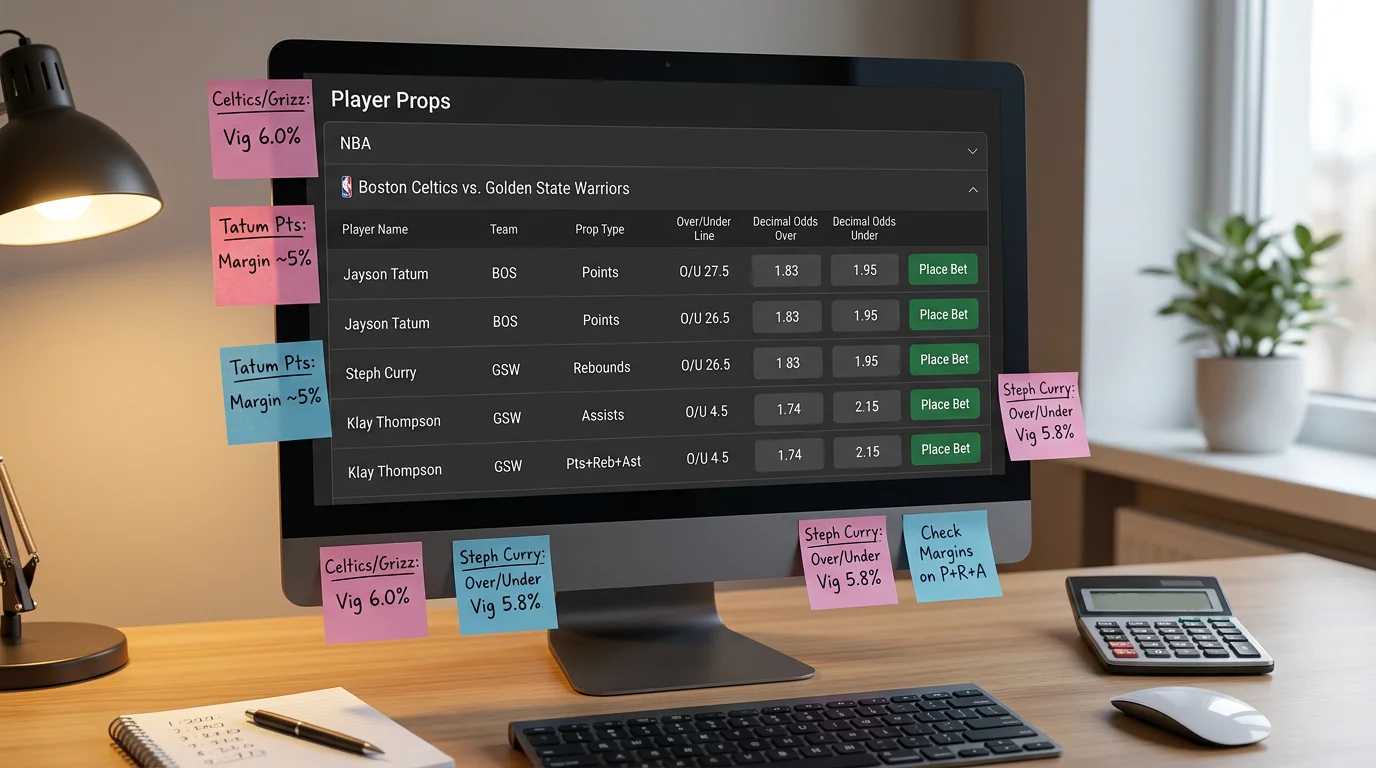
The picture changes once you move to props. A standard two-way NBA player prop priced at 1.85 against 1.85 produces an implied overround of 8.11 percent. A prop priced at 1.83 against 1.83 produces 9.29 percent. A prop priced at 1.80 against 1.80 produces 11.11 percent. The lower the offered price on both sides, the fatter the bookmaker’s theoretical hold – and the UK book that quotes 1.80 against 1.80 on a rebound prop is taking close to two-and-a-half times the margin they’re taking on the moneyline for the same game.
Asymmetric prop pricing layers in additional complexity. A points-prop quoted at over 22.5 at 1.95 against under 22.5 at 1.75 isn’t a 4.72 percent overround market – the implied probabilities are 51.28 percent on the over and 57.14 percent on the under, summing to 108.42 percent, for an 8.42 percent margin. Asymmetric pricing usually signals the bookmaker’s directional preference: they’re shading the line to attract action on one side, often because the other side has been backed too heavily already. For a punter who can identify the shaded side and verify it as the correct side anyway, the asymmetric price can occasionally represent value. Most of the time, though, the asymmetry is the bookmaker telling you they think one side is more likely than the other, and they’re charging you more to disagree.
Why props are structurally harder for bookmakers to price
The temptation is to read the prop overround as bookmakers being greedy. The honest picture is more nuanced. Three structural challenges genuinely make prop pricing harder than mainline pricing, and each one feeds into the fatter margins.
The volume problem is the first. NBA mainlines attract enough betting volume that the closing line is an extraordinarily efficient predictor of outcome – the sharps move the market, the recreationals fill in, and the price converges on something close to reality by tip-off. Props don’t have that volume. A points prop for a starter on a non-marquee game might attract dozens of bets, not thousands. The bookmaker can’t lean on the crowd to refine the line, so the trader has to do more of the work themselves, and the safer the trader plays it, the wider the spread between over and under.
The information asymmetry problem is the second. On a mainline, the bookmaker and the public are roughly equally informed – both have access to the rosters, the recent form, the injury reports. On a prop, particularly for non-stars, a connected punter can have genuinely better information than the bookmaker’s projection model. A beat-writer mention that a player has been at the gym late, a rotation hint in a coach’s post-practice availability, a quiet word from a trainer – these things genuinely move prop probabilities, and the bookmaker has to price defensively against the punters who’ll act on them.
The tail-risk problem is the third. A mainline outcome is bounded – a team wins by 8, or by 10, or by 14, but the realised result lives in a relatively predictable distribution. A prop outcome can blow up. A player can foul out in nine minutes and put up 4 points on a 16.5 prop. A player can erupt for 41 against a brutal defensive matchup nobody saw coming. The variance on individual prop outcomes is wider than on team outcomes, and that variance translates into wider pricing.
The 2025 NBA integrity case involving Terry Rozier and Chauncey Billups added a fourth structural pressure. Adam Silver was explicit afterwards that the league had asked partner sportsbooks to pull back specific prop bets, particularly on two-way players where the smaller competitive stake created manipulation risk. UK books followed the US lead. The result is that the props that remain post-Rozier carry even fatter margins than they did before, because the surviving markets concentrate liquidity and the books price more cautiously to insulate against the increased reputational exposure.
Alternate prop lines and where the margin redistributes
Most UK books offer alternate lines on major player props – over 19.5, over 21.5, over 23.5, over 25.5 points, each at a different price. The instinct is to read this as a menu of equally-priced choices. It isn’t. The bookmaker prices the alternate lines to reflect different probability slices, and the overround often gets redistributed across the alternate lines in ways that occasionally favour the punter.
The mechanism. The headline line – usually the one the bookmaker thinks is closest to a true coin-flip – carries the fattest margin, because it’s the most-bet market. The alternate lines further from the headline attract less volume, and the bookmaker can sometimes afford to price them at lower margin to encourage diversification of action. The further you push to either tail, the more eccentric the pricing becomes, but the occasional pocket of value lives there.
The catch is that most alternate-line value is locked away behind small stakes. Bookmakers limit alternate-line markets aggressively, particularly the further tails, because the prices are more sensitive to information asymmetry and the volume is too low to reliably balance the book. A 30.5-point alternate at 9.00 might be 3 percent better priced than the implied probability suggests, but if the max stake is £20, the expected value of perfect deployment over a full season is forgettable. The deeper question of how alternate lines fit into a full prop workflow connects directly to my piece on NBA prop bet settlement rules at UK bookmakers, because settlement rules and alt-line behaviour interact more than most punters realise.
The low-volume prop trap
The most expensive prop bets I’ve ever taken were on markets I shouldn’t have been in. Specifically: rebound, assist, and stocks props for rotation players on national-broadcast games. The pricing on these markets is fat – sometimes 12 to 14 percent overround on lines I’d never have touched on a mainline equivalent. The reason punters keep returning to them is that they feel knowable. You know this guy averages 5.2 rebounds. The line is 4.5. The over feels obvious. The bookmaker knows you’ll feel that way, and they price accordingly.
The recurring trap. Recent-form averages don’t price NBA props well, because the variance on individual game outcomes is much wider than the average suggests. A player averaging 5.2 rebounds will hit under 4.5 in something like 40 percent of games – frequently enough that an over priced at 1.83 isn’t the value bet it looks like. The bookmaker’s pricing model captures the volatility better than the punter’s mental average does, and the fat overround on these markets ensures the bookmaker is paid for the variance.
The other recurring trap. Late-news rotation changes hit low-volume props hardest. A starter limited to 22 minutes because of foul trouble blows up a points prop without affecting the team total. A back-up suddenly getting 28 minutes because of an injury changes every assist and rebound prop for the rotation. The punters with the fastest information win these markets; the punters relying on the line as quoted at 6pm UK lose them. If you cannot trust your reaction time on injury news, low-volume props are the wrong place to live, regardless of how confident your projection feels.
How wide can the overround on an NBA rebound prop get at UK books?
On low-volume rebound props for rotation players, I’ve seen overrounds push past 14 percent at major UK books – roughly triple the margin on a standard NBA mainline. The structural drivers are the lower betting volume, which gives the bookmaker less crowd-sourced pricing signal, the information asymmetry between connected punters and the bookmaker’s projection model, and the tail-risk variance on individual prop outcomes. Two-way and fringe-rotation player props tend to carry the fattest margins, and the post-Rozier integrity pressure of late 2025 has widened the surviving markets further.
Are alternate prop lines (e.g. 21.5 points vs 24.5) ever priced more efficiently?
Occasionally, yes. The headline prop line – the one nearest a true coin-flip – carries the fattest margin because it attracts the most volume. Alternate lines further from the headline sometimes carry slightly lower margins because the bookmaker is willing to encourage diversification of action away from the main line. The catch is that alternate-line markets are heavily stake-limited, particularly the further tails, so the realised value of finding a well-priced alternate is usually modest for any individual punter.
Written by the editors at nba bet of the day.