Bookmaker NBA Prop Settlement Rules for UK Punters
 Available in US
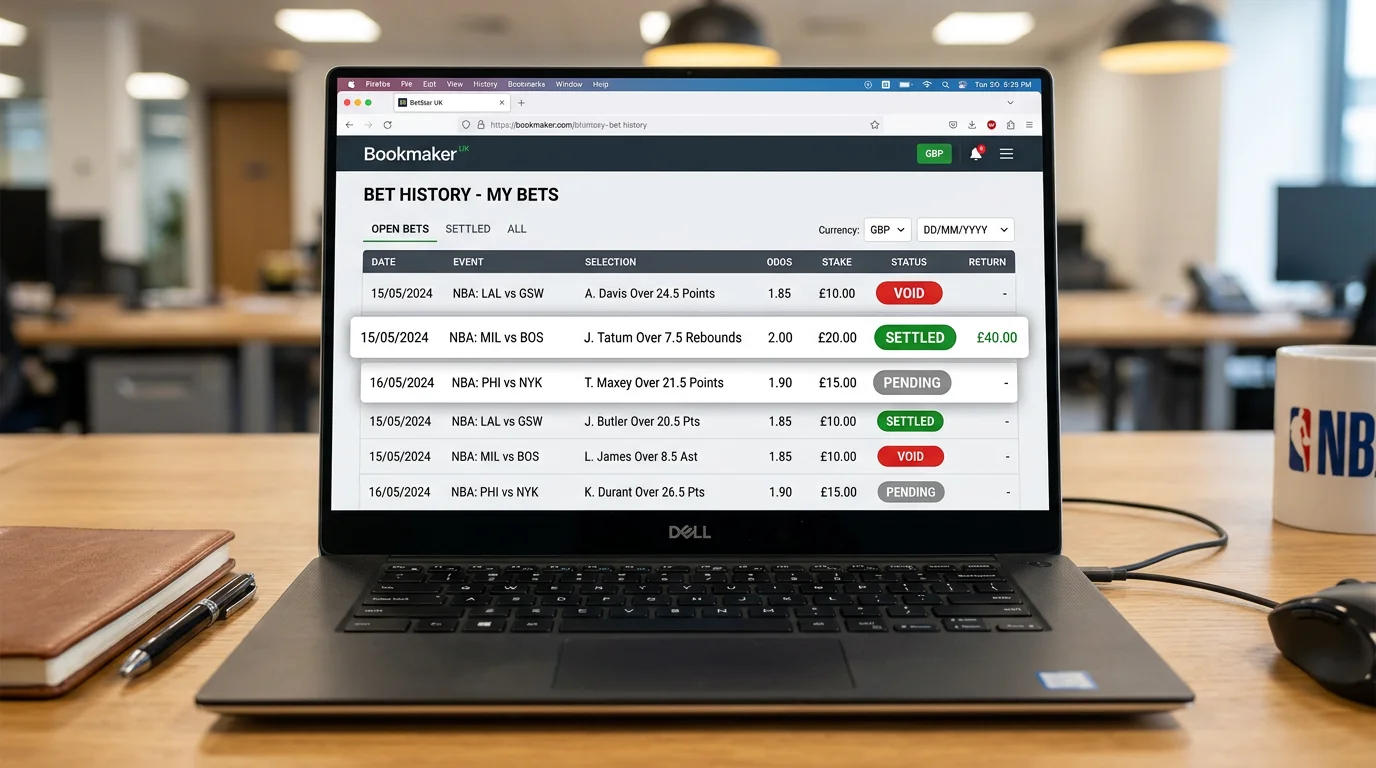
Voiding Criteria: Understanding DNP Scratches and Injury Clauses in Player Props
October 2019, opening week of the season. I had £180 on a Klay Thompson points prop. He was listed as questionable on the injury report 45 minutes before tip-off. He came out for warm-ups. He didn’t start. He didn’t enter the game. My prop, which I’d assumed would void cleanly as a did-not-play, was settled as a loss because the bookmaker’s rule that season required the player to be officially scratched in the final pre-tip lineup card, not merely absent from the rotation. I’d missed the rule. The bookmaker hadn’t.
What I learned that night is the principle that has governed my prop betting ever since. The published settlement rules are the contract. Whatever you imagine they say, whatever the spirit seems to suggest, whatever “obviously” should happen – none of that survives contact with the actual rulebook. The phrase the trader I once spoke to used was “the small print is the bet”. Six years later I still write it on every prop slip I take. The 2025 NBA integrity case involving Terry Rozier – a $26.6 million-a-year player who was indicted alongside more than 30 others in October 2025 – accelerated tightening of these rules across UK books, because the prop categories most exposed to manipulation are the ones the bookmakers needed to harden first.
Did-not-play and the void mechanic
The cleanest case is the player who simply doesn’t play. Lineups posted, name not on the active list, no minutes recorded. At every major UKGC-licensed book, this scenario voids the prop and refunds your stake – provided the scratch happens before tip-off.
The wrinkles cluster around the word “before”. Different books define the cutoff point differently. Some treat the official starting lineup announcement, typically 30 minutes before tip-off in the US time zone of the game, as the binding moment – a player removed from that lineup voids the prop, a player on that lineup who doesn’t enter the game does not. Other books extend the protection to any pre-game scratch announced before the first tip, which is more generous to the punter. A handful of books, particularly the more aggressive operators, take the inverse approach: any player listed on the active roster who doesn’t accumulate the prop’s minimum minutes settles as the over or under depending on the line. Two-way and fringe-rotation players are exactly the prop category Adam Silver flagged in late 2025 when he said the league had asked partner sportsbooks to pull back specific prop markets “where it’s too easy to manipulate something that seems small and inconsequential” – meaning the rulebook on these markets has moved fastest.
The practical guidance. Read your specific bookmaker’s prop rulebook before placing any bet on a player listed as questionable, probable, or recently nursing a knock. The 90 seconds it takes to check is the cheapest insurance available in NBA betting. If the rulebook says “void if the player does not start”, and the player is questionable, you are taking a different bet from someone betting at a book whose rulebook says “void if the player records zero minutes”.
Screenshot the rulebook every time you discover a new edge case. I’ve kept a folder for six years of every prop rulebook screenshot at every account I hold, dated to the day I captured it. That archive has settled three IBAS disputes in my favour, because the rules quietly change, and the version that mattered is the version live on the day you placed the bet.
Early-exit injury rules and the threshold question
A more contested category. Player starts, plays some meaningful minutes, then exits with an injury – either at half-time, late in the game, or partway through any quarter. The prop is settled at whatever stat line the player accumulated before exiting. Or the prop is voided. Or the prop is settled depending on whether a minute threshold was reached. The answer depends entirely on the bookmaker.
Three main approaches dominate the UK market.
The first approach is the strict settlement model. If the player tips off the game, the prop is live, and the prop settles at whatever final stat line is recorded – regardless of injury. A player who scores 6 points before exiting with a hamstring tweak in the second quarter settles the over 22.5 prop as a loss, full stop. The argument for this model is that it eliminates ambiguity and forces punters to factor injury risk into the line they’re betting on. The argument against is that it asks punters to absorb tail risk that the bookmaker is better positioned to absorb.
The second approach is the minutes-threshold model. The prop is live once the player accumulates a defined minimum of minutes – commonly 12 minutes, 18 minutes, or 26 minutes, depending on the book. If the player exits before reaching the threshold, the prop voids; once the threshold is reached, the prop settles at the final stat line. This is the most punter-friendly model and the model that has gained ground across the UK market over the last three years.
The third approach is the half-completion model. The prop is live if the player participates in at least half of the game – typically meaning they’re on the floor for some portion of both the third and fourth quarters. This model is used by a smaller subset of operators and is less common for full-game props than for combo props.
The reason this matters is straightforward. Without checking the rulebook, you cannot know which model your bookmaker uses, and the model materially changes the bet’s expected value. A points prop on a starting wing has very different EV at a strict-settlement book than at a minutes-threshold book, because the implicit insurance against early exit is worth real money on a player with any injury history.
Minutes-threshold clauses and the granularity that breaks bets
The minutes-threshold rule is the most contested settlement clause in NBA prop betting, and the granularity of how the threshold is measured matters even more than which threshold the bookmaker uses.
Most books measure minutes against the official NBA box score, with the player’s recorded minutes rounded to the nearest minute. A player listed as playing 11:48 in the box score is treated as 12 minutes; a player at 11:32 is treated as 12 minutes; a player at 11:15 is treated as 11. Different rounding conventions across books produce edge cases where the same on-court result settles differently – and these are exactly the disputes IBAS sees most often on NBA props.
The other granularity question. The “minutes played” field in the box score doesn’t always match the broadcast clock – players are credited with minutes for any portion of a minute they’re on the floor, so a player checked in for the final 12 seconds of a quarter is credited with 1 minute, not 0. That can flip a threshold rule unexpectedly. I’ve seen disputes where a player checked into the closing seconds of the first quarter to defend an inbound play, was credited with 1 minute, and the prop settled live because the book counted it as a real minute. The bookmaker’s rule said “5 minutes minimum”, the box score said 5 minutes, and the punter’s intuition that the player had barely participated didn’t enter the equation.
Dispute and screenshot protocol
The unavoidable reality of prop betting at any volume is that you will eventually have a settlement dispute, and your ability to win that dispute will depend almost entirely on the quality of the evidence you bring to it. The bookmaker’s records are the bookmaker’s records. Yours need to be at least as good.
My protocol, refined over a decade of disputes both won and lost.
Screenshot the bet slip at the moment of placement, showing the line, the price, the stake, the market description, and the timestamp. Most books email a confirmation; that email is also acceptable evidence, but screenshots travel better through IBAS submission portals.
Screenshot the relevant section of the bookmaker’s prop rulebook at the moment of placement. The rulebook page itself should be timestamped, and the URL should include the bookmaker’s domain. If the rulebook is in a PDF rather than a web page, save the PDF locally with the date in the filename.
If the bet relates to a player with an injury status, screenshot the official NBA injury report at the moment of placement and again at tip-off. The injury report’s timestamp matters because the rulebook usually defines the cutoff point for the “scratch” definition relative to tip-off.
If the prop settles in a way you believe is incorrect, screenshot the box score from the NBA’s official source – basketball-reference, the NBA’s own stats page, or the broadcaster’s stats overlay. Cross-reference any minutes-played figure across at least two sources, because data corrections sometimes flow through with a lag.
Open the internal dispute with the bookmaker first. If they decline, escalate to IBAS through the bookmaker’s published dispute pathway. IBAS adjudication is free and binding on the bookmaker. The process takes 4 to 12 weeks typically, and the outcome is determined by the published rules in force at the time the bet was placed – which is why the rulebook screenshot from the moment of placement is the single most important piece of evidence you’ll provide.
The recurring lesson across all the settlement disputes I’ve been part of is that the bookmaker is consistent and the punter is variable. The bookmaker’s rules apply identically to every customer; the punter’s recollection of those rules tends to drift. The discipline of treating every prop bet as a contract – with the rulebook as the contract terms – is what protects you when something goes wrong. The broader question of how rotation and load-management decisions feed back into the same settlement risk is something I cover in my piece on NBA load management and its impact on UK betting markets.
Are NBA player props automatically voided if the player is scratched after lineups are released?
It depends on the bookmaker. Some UK books treat any pre-tip-off scratch as a void, regardless of when in the pre-game window it occurs. Others bind to the official starting lineup announcement, typically 30 minutes before tip-off in the game’s local time zone, and a player removed after that point still triggers a void. A smaller group of books require the player to record zero minutes for the prop to void. The published rulebook is the binding document; check it before placing the bet, particularly for any player listed as questionable or probable on the injury report.
Which UK bookmakers use a minutes-played threshold for prop settlement?
The minutes-threshold model has gained ground across the UK market over the last three years, but the specific threshold varies. Common values are 12 minutes, 18 minutes, and 26 minutes, with the lower thresholds typically applied to player-specific points props and the higher thresholds applied to rebounds and assists. Different bookmakers measure minutes against different rounding conventions – some round to the nearest whole minute, others round down – which produces edge cases at the threshold boundary. Always confirm both the threshold value and the rounding rule before placing a prop on a player with injury risk.
Published by the nba bet of the day team.