Fundamental NBA Point Spread Betting Tactics for UK Punters
 Available in US
- Handicap Market Purpose: Balancing Basketball Slates via Selective Line Betting
- The vig is the cost of access
- Key numbers in NBA spreads
- Home court is not what it used to be
- Public bias and the contrarian temptation
- Spread movement and what it tells you
- The blowout problem
- Live spread betting and the velocity problem
- The selectivity that separates spread bettors
Handicap Market Purpose: Balancing Basketball Slates via Selective Line Betting
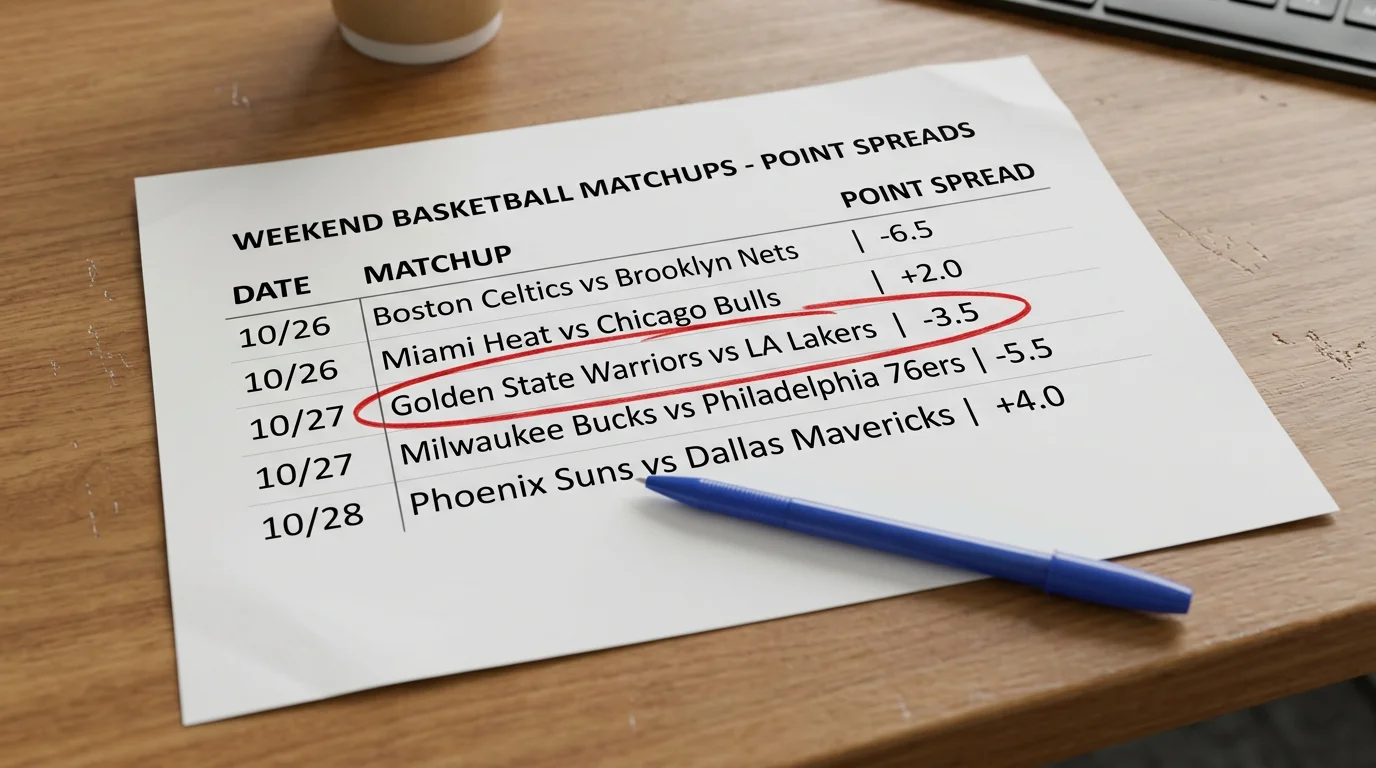
When I started betting NBA, I treated the point spread as a punishment imposed on favourites. It took me an embarrassingly long time to understand it is actually a market-clearing mechanism, designed to balance money on both sides so the bookmaker locks in their margin regardless of outcome. The Lakers are not minus 6.5 because they will win by 6.5. They are minus 6.5 because that is the number at which roughly equal money is willing to back both teams. Understanding the difference is the entire foundation of spread betting.
For UK bettors used to fixed-odds markets dominant in football, the spread is a different conceptual mode. It is not predicting a winner. It is predicting whether a team’s margin of victory or defeat will fall above or below a specific number, with the bookmaker setting that number to attract balanced action.
The vig is the cost of access
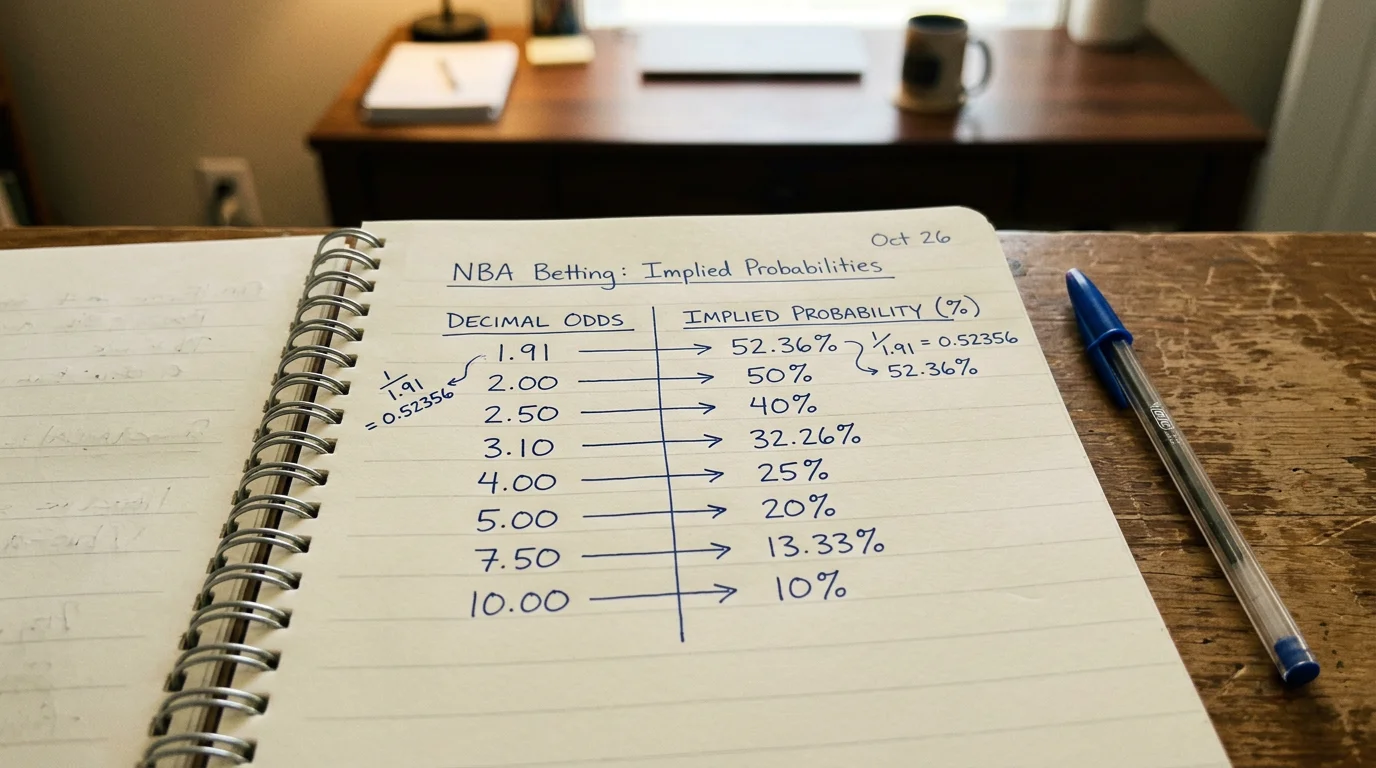
Standard NBA spread bets are offered at decimal odds around 1.91 on both sides, which corresponds to a hold of roughly 4 to 5 percent across UK sportsbooks for the main spread market. That hold is the bookmaker’s cut on every transaction. Industry-wide US sportsbook data showed singles markets averaged a 4.4 percent margin in 2025 – UK pricing on NBA spreads sits in the same range on most major books and on the most heavily traded games, though it widens on less-traded matchups.
What this means in practice: you have to win more than 52.4 percent of your spread bets at standard pricing just to break even. That is the threshold most bettors fail to clear, not because they cannot pick winners 52 percent of the time, but because the vig compounds across hundreds of bets in a way intuition does not register. Every losing bet costs you the stake. Every winning bet returns less than the stake doubled. The asymmetry is the entire reason books are profitable.
Shopping prices matters even within standard pricing. A spread at 1.95 instead of 1.91 changes the break-even win rate from 52.4 percent to 51.3 percent. Across a thousand bets, those tenths of a percent are bankroll-defining.
Key numbers in NBA spreads
NBA spreads do not have the same key numbers as NFL – 3 and 7 are not nearly as decisive in basketball as they are in American football. NBA margins of victory distribute more smoothly, with no single number dominating. The closest thing to a key number is the difference between minus 2.5 and minus 3, which captures a meaningful percentage of one-possession games where a late three changes the outcome.
Other notable numbers include the gap between minus 6 and minus 7 (some weight to two-possession games extended by a late three) and the area around minus 9 and minus 10 (the boundary between a tight one-possession-late game and a comfortable two-possession buffer). These are softer key numbers than NFL has, but they still matter when you are choosing between buying half a point at the cost of vig.
The general rule: buying points on NBA spreads is rarely worth it. The half-point you move the line is priced into the increased odds, and the expected value of the move is typically slightly negative. Move the spread only if you have a specific belief that the half-point change will land on a high-frequency margin – which in NBA is rare.
Home court is not what it used to be
Historical NBA home-court advantage was roughly 3 to 4 points. The bookmaker would set the spread expecting that bump, the public would lean home, and the line would adjust accordingly. That number has eroded substantially over the past decade. Home teams in the 2020s have won 55.1 percent of games – down from 66.2 percent in the 1980s.
The decline has multiple causes: chartered flights for every team, better sleep science, the rise of three-point shooting which travels well, and reduced influence of referees in an instant-replay era. Whatever the reasons, the effect is a structural shift in how spreads should be priced.
The market has largely adjusted. Home court is now typically worth 2 to 2.5 points in the spread. Bettors anchored to the old 3-point number are systematically overvaluing home teams and undervaluing road favourites. This is one of the few persistent edges available to UK bettors who pay attention to the data trend.
Public bias and the contrarian temptation
Public money in NBA spread markets flows toward favourites, popular teams, and overs. This is a documented and stable pattern. Books sometimes shade lines slightly to capture the public bias on either side, which can produce small inefficiencies on the unpopular side of marquee games.
The temptation is to bet against the public reflexively. This is wrong more often than it is right. The public is not always wrong. The public is often right, just for the wrong reasons, and the line accounts for both the rightness and the bias. Betting “against the public” as a strategy gets crushed when the favourite is genuinely better.
What works: identifying specific games where the line has clearly shifted in response to public action – the line moves toward the popular side without any underlying information change. Those are spots where the contrarian play has real expected value. Generic anti-public betting does not. The distinction is between a strategy informed by line movement and a strategy informed by sentiment, and only the first one is profitable over time.
Spread movement and what it tells you
Line movement in NBA spread markets carries information. When the spread moves from minus 4.5 to minus 6 in the hours before tip-off, something has happened: a key player is questionable, the public has piled on one side, or sharp money has hit the unpopular side. Reading which of those is happening is part of the skill of being a spread bettor.
Sharp money typically moves lines early, hours before tip-off, before the public is heavily engaged. Public money moves lines closer to tip-off, especially in the final 30 minutes. If a line moves your way close to tip-off, you are typically following sharp money or fading the public – both are good signs. If a line moves your way early in the day, you are likely on the same side as sharp action, which is also good.
If you took a side and the line moves heavily against you, you have a decision: either you got there first and the market is wrong, or you missed something the market caught. Most of the time it is the latter. New information appears, and your bet is now on the wrong side of the updated probability. Recognising this early can save you from doubling down on a stale opinion, and it is one of the strongest arguments for tracking whether your prices systematically beat the close across hundreds of bets.
The blowout problem
Garbage time scoring is one of the structural challenges of NBA spread betting. A team up 18 with five minutes left will rest their starters, the deficit will compress as the trailing team runs against the favourite’s bench, and the final margin will land closer to the spread than the actual flow of the game would have suggested. This means betting NBA spreads is partly a bet on how each coach handles the back end of a decided game.
Some coaches keep starters in longer than others. Some bench earlier. The team-level tendencies matter for spread bettors because they predict how mismatched games will close. A team that pulls starters at the 8-minute mark of the fourth in a 20-point lead will see the spread compressed; a team that plays them until 4 minutes will see it expanded.
This is information you can extract from watching enough games. There is no public stat for “garbage time rotation tendency,” but if you follow a handful of teams closely, you will know who covers in blowouts and who lets the margin shrink. Coaches change, philosophies shift, and the database stays current only as long as you keep watching.
Live spread betting and the velocity problem
Spreads update in-game on every UK book that offers live betting. The lines move violently – a 10-0 run can shift the live spread by 4 or 5 points, and the spread will re-anchor immediately when the run ends. Betting live spreads is high-velocity work, and the books price the volatility aggressively.
The opportunity in live spreads is identifying when the line has overreacted to a run. If a team goes on a 10-0 burst but you can see structural reasons the run will not continue – foul trouble for the hot shooter, the bench coming in for the other team, scheme mismatch favouring the trailing side – the live spread offers value before the market settles. This is harder than it sounds and is the part of betting where I lose the most money when I am tired.
My rule for live spreads: bet only the early game and the final minutes. The middle of games is where market efficiency is highest because both sides have had time to react. The first five minutes and the last five minutes are where most live edge appears, because pricing is reacting to limited or unusual information.
The selectivity that separates spread bettors
I bet maybe 25 NBA spreads a week during the regular season. That is across 15-plus games per night and a 6 or 7-day schedule. The vast majority of available spreads do not have edge worth pursuing – the line is close enough to fair that the vig swallows any small disagreement I have. Betting every game is the most common failure mode of UK NBA spread bettors.
What works: handicap every game, identify the few where your projection diverges meaningfully from the line, bet those, leave the rest alone. The discipline of skipping bets is the discipline that produces long-term profit. The high of betting every game is the high that produces long-term losses. There is no version of NBA spread betting where betting more leads to better results, but there are countless versions where betting less does.
What is the standard hold on NBA spreads at UK books?
Around 4 to 5 percent on the main spread market on heavily traded games, slightly wider on less liquid markets. Price shopping can reduce this meaningfully across a long sample.
Is home-court advantage in NBA still worth 3 points?
No. Home teams in the 2020s have won around 55 percent of games, down from 66 percent in the 1980s. The market has largely adjusted, but bettors anchored to the old number still overvalue home teams.
Should I buy points to move an NBA spread?
Rarely. The vig increase usually outweighs the value of the half-point move because NBA margins do not cluster on key numbers the way NFL margins do.
Created by the ”nba bet of the day” editorial team.