Regulatory UK Gambling Advertising Rules for NBA Sites
 Available in US
- Free Bet Compliance: ASA and CAP Wording Restraints for Betting Sites
- CAP Code essentials every NBA punter eventually encounters
- The whistle-to-whistle ban and how it touches NBA broadcasts
- Free-bet wording and the slow death of “risk-free”
- Affiliate content disclosures: where the rules touch every NBA punter
Free Bet Compliance: ASA and CAP Wording Restraints for Betting Sites
In 2018, half the NBA betting sites I worked with were running a “risk-free first bet” promotion. By 2019, the wording had quietly mutated to “money-back as a free bet on first bet.” In 2020, even that softened to “stake refunded as a free bet.” Same product, three different framings inside two years, because the ASA had ruled “risk-free” misleading every time it surfaced. That evolution tells you almost everything you need to know about how UK gambling advertising regulation works in practice – slow, persistent, applied across the industry by precedent rather than blanket ban.
For NBA betting specifically, the rules matter more than ever. The UK gambling industry spends around £2 billion a year on advertising, and the Gambling Commission’s own data shows that a person with a problem-gambling profile is nine times more likely to receive a free-bet offer than the average customer. Whatever you think about the politics of that, it’s the regulatory context everything else lives in. If you bet NBA at a UKGC site, the advertising you see has been through filters most punters don’t even know exist.
CAP Code essentials every NBA punter eventually encounters
The Committee of Advertising Practice – CAP – writes the rules that govern UK non-broadcast advertising, and a parallel body called BCAP covers broadcast. Both codes have gambling-specific sections, and the Advertising Standards Authority enforces them. Penalties are reputational rather than financial in most cases, but the cumulative effect on industry practice has been substantial.
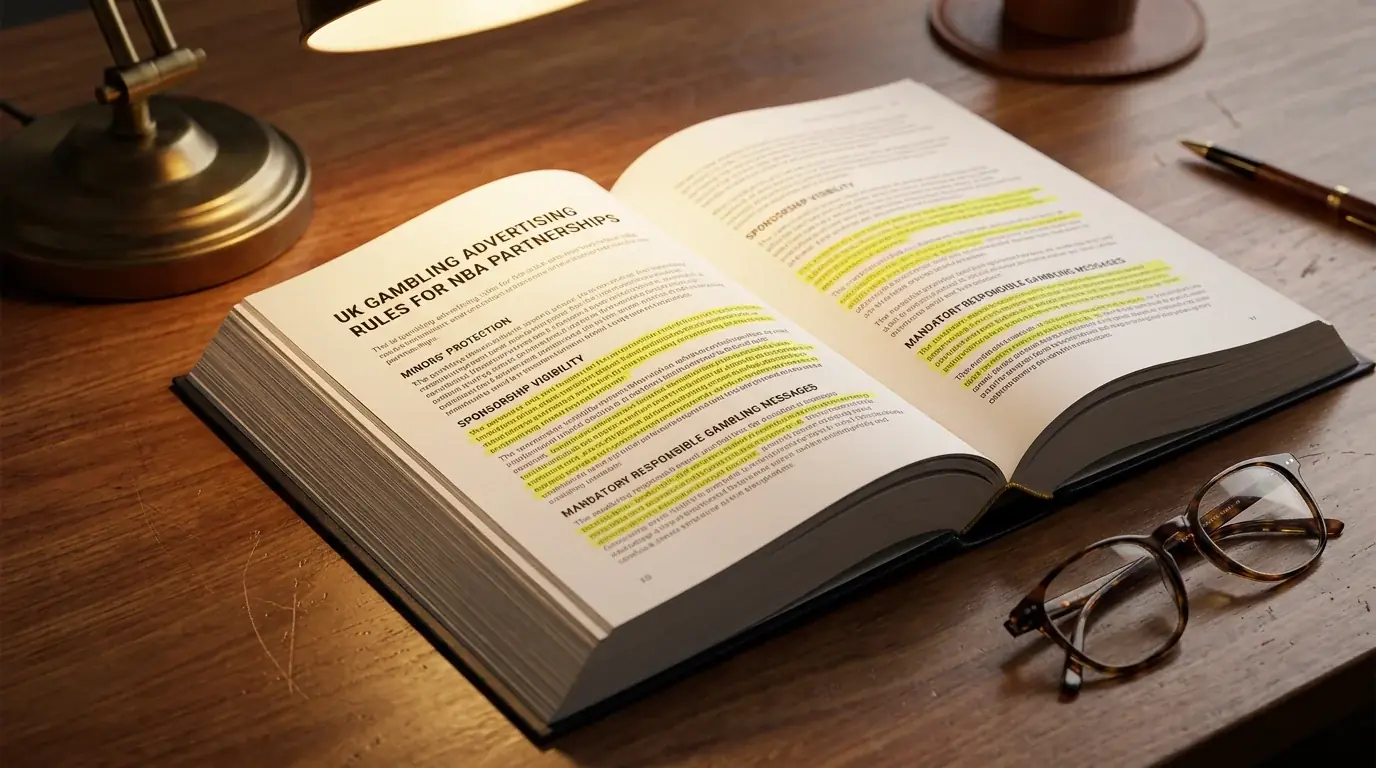
Three CAP requirements show up in NBA betting advertising almost every time. First, ads cannot portray gambling as a way to achieve financial security or solve problems. Second, ads cannot link gambling to seduction, sexual success, or enhanced attractiveness. Third, ads cannot strongly appeal to under-18s – which since 2022 has been interpreted strictly enough to remove athletes under 25 from significant roles in UK gambling marketing. None of these prohibitions sound like they’d affect NBA betting specifically, but the third one ended up barring the use of most active NBA players in UK ad campaigns, since a sizeable cohort of stars are under 25 at any given moment.
The other CAP requirement that quietly shapes everything is the standard around “significance of conditions.” Bonus terms cannot be buried, free-bet conversion rules must be reasonably accessible from the headline offer, and wagering requirements must be presented in a way the ASA considers prominent. The slow death of “risk-free” as a phrase is one consequence; the rise of dense small-print blocks at the bottom of promotional emails is another.
The whistle-to-whistle ban and how it touches NBA broadcasts
The voluntary whistle-to-whistle ban, introduced by the Betting and Gaming Council in 2019, prohibits televised gambling ads during live sports broadcasts before 9pm – from five minutes before kick-off to five minutes after the final whistle. It applies to Premier League football, where the impact has been visible and material, and to all televised live sport on UK channels.
For NBA, the relevance is more nuanced because the bulk of UK NBA viewing now lives on Prime Video – UK audiences on the platform are up 312 percent year on year in the first season of the league’s 11-year UK deal, with overall viewership demand up 444 percent – and on the NBA’s own digital products, where UK app engagement is up 52 percent year on year and average time spent has climbed around 24 percent. The whistle-to-whistle ban is structured around traditional broadcast slots and pre-roll ad inventory, neither of which dominates the modern NBA viewing experience for UK punters.
The result is something of an inconsistency. NBA fans watching a Lakers game at 3am on Prime Video are subject to a different advertising environment than football fans watching at 4pm on Sky Sports. The Gambling Commission and the Betting and Gaming Council have both flagged the streaming gap as an area under review, and the regulatory minister Stephanie Peacock has been explicit in Parliament that the current framework needs modernising. Whether the next round of rules tightens streaming-era advertising more aggressively, or simply codifies what the industry is already doing voluntarily, is the live question across 2026.
Free-bet wording and the slow death of “risk-free”
The free-bet category is where CAP enforcement has bitten hardest. The reasons are straightforward: free bets are the bonus product most directly linked to harm metrics, and the wording around them has historically been the most misleading. Every iteration of UK gambling reform has tightened the language operators can use.
The current state of play. “Risk-free” is functionally dead as a phrase, with the ASA upholding multiple complaints against operators who deployed it. “Money back” must clearly indicate whether the refund arrives as cash or as a free bet – these are not equivalent, since a free bet does not return the stake on a winning settlement, only the net winnings. “Free bet” itself remains permitted, but every promotional reference must be reasonably accompanied by the wagering requirements and qualifying conditions. Wagering requirements that exceed a certain threshold attract additional scrutiny under the CAP Code’s significance-of-conditions rule.
The Gambling Harms Levy, which took effect in April 2025 with NHS England formally administering the treatment, prevention, and research strands, has put additional pressure on the value-versus-harm calculation around bonus product. Stephanie Peacock has been explicit about the direction of travel – that the regulatory regime needs to modernise, and that restricting bonus and free-bet offers is part of how the government plans to bring it up to date. Operators have responded by quietly reducing the headline value of their NBA welcome offers over the last twelve months. The “£30 in free bets when you stake £10” deal of 2022 is more often a “£20 in free bets when you stake £10” deal in 2026, and the wagering requirements behind both have lengthened.
Affiliate content disclosures: where the rules touch every NBA punter
Most NBA punters discover bookmakers not through the bookmakers themselves but through affiliate content – review sites, tipsters, comparison platforms, YouTube channels. The CAP Code applies to that affiliate content in the same way it applies to direct advertising, and the enforcement has tightened materially since 2020.
Three disclosure rules now apply to almost any UK-targeted NBA affiliate content. First, paid commercial relationships must be disclosed clearly – not buried in a footer, not hidden behind a hover-state, but disclosed in a way an average reader can identify before engaging with the recommendation. Second, recommendations cannot present commercial offers as editorially-selected best-in-class without genuine editorial process behind that claim – the “top 10 NBA bookmakers” article that’s actually a paid placement list is a regulatory problem, not just an ethical one. Third, the gambling-specific disclosure standards from the CAP Code apply: 18+ markings, BeGambleAware references, and licence-status confirmations must be present and accessible.
The reason this matters for you as a reader is straightforward. The standards have made the affiliate ecosystem more transparent than it was a decade ago, which means the content you read about NBA betting has a clearer regulatory floor. Whether any particular site treats that floor as a ceiling or as a starting point is a separate question – and one of the better ways to evaluate any affiliate-style NBA betting resource is to check whether its disclosures are visible, specific, and recent. Anyone serious about playing in this market also needs to understand the harm signal that drives a lot of the advertising reform, which I cover in my piece on UK free bets and where the real value sits behind the headline numbers.
Can a UK affiliate publish an NBA ‘risk-free bet’ offer under current CAP rules?
In practice, no. The ASA has upheld multiple complaints against the use of ‘risk-free’ to describe stake-not-returned free-bet offers, on the basis that the wording misleads consumers about whether they can lose money on the qualifying bet. Affiliates still bound to the CAP Code in their UK-facing content must use accurate descriptors such as ‘stake refunded as a free bet’ or ‘money back as a free bet’ rather than ‘risk-free,’ and the wagering and conversion terms must be reasonably accessible alongside the headline offer.
Do whistle-to-whistle restrictions apply to NBA broadcasts in the UK?
The voluntary whistle-to-whistle ban introduced by the Betting and Gaming Council applies to live televised sport on UK channels, with gambling ads prohibited from five minutes before kick-off to five minutes after the final whistle for any pre-9pm broadcast. For NBA, the majority of UK consumption now lives on Prime Video and the NBA’s own digital platforms, where the broadcast-era restrictions don’t map cleanly. The Gambling Commission has flagged the streaming gap as a live area of review, but no equivalent restriction is currently codified for streaming-only NBA coverage.
Prepared by the nba bet of the day editorial staff.