Comparing Decimal and Fractional NBA Odds Formats in the UK
 Available in US
- American vs Decimal Lines: Avoiding Inadvertent Negative-Odds Layout Mistakes
- Decimal: the UK NBA default and why it should be yours
- Fractional: the British legacy that won’t quite die
- American odds: translating what every handicapper quotes
- Implied probability and the conversion that ties everything together
American vs Decimal Lines: Avoiding Inadvertent Negative-Odds Layout Mistakes
It was 2016. I was a year into NBA betting, and I’d just read a fantastic write-up by an American handicapper. The pick was Spurs -3.5 at -110. I logged into my UK account, saw the same line at 10/11, and almost laughed at the value the Americans were missing. Then I did the maths properly. The “value” I thought I’d spotted didn’t exist. 10/11 and -110 are the same price. I’d been ready to stake an extra two units on a non-edge because I couldn’t read the format I was looking at.
Most UK NBA punters live somewhere between two worlds. The home market quotes in fractional or decimal, the analysis they consume – handicappers, podcasts, model-driven Twitter accounts – quotes in American. Until you can flip between all three in your head, you cannot meaningfully compare a US pick to a UK price. Worse, you cannot tell when your own bookmaker is taking a heavier margin than the consensus. That’s where this piece earns its keep.
Decimal: the UK NBA default and why it should be yours
Decimal odds are the cleanest format ever invented for serious bettors. The number is the total return per unit staked. A decimal of 2.00 returns £2 for every £1 staked – your £1 back plus £1 profit. A decimal of 1.91 returns £1.91 – your £1 back plus 91p profit. A decimal of 3.50 returns £3.50.
That single property makes decimal the format of choice for anyone running expected-value calculations. To get the implied probability of a market, you divide one by the decimal price: 1 ÷ 1.91 = 0.5236, or 52.36 percent. To compare two prices, you just compare two decimals. To calculate return on a £100 stake, you multiply. There is no mental arithmetic in any of it.
Every major UKGC-licensed sportsbook lets you set decimal as the default display in your account preferences. The fact that the British retail tradition is fractional is a cultural artefact, not a strategic one. NBA markets in particular benefit from decimal because American handicapping content converts directly through implied probability – you’ll never bridge to a US-priced edge cleanly without it. The US sports betting market is now too big to ignore for context: total US handle reached $166.94 billion in 2025 with revenue of $16.96 billion, and basketball makes up around 28 percent of that wagering volume. If you’re reading any of the public analysis, you’re reading it in American odds.
Fractional: the British legacy that won’t quite die
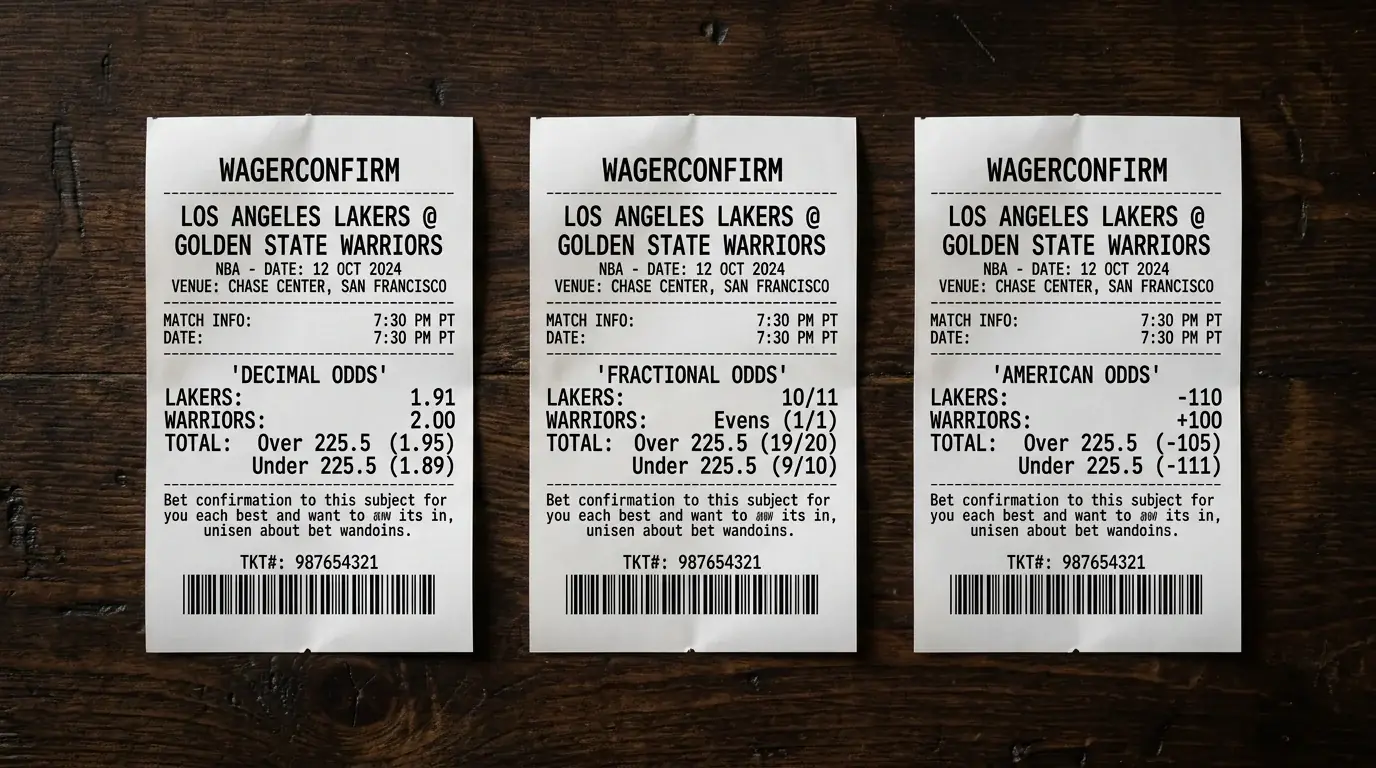
Fractional odds describe profit relative to stake. 10/11 means stake 11 to win 10. 6/4 means stake 4 to win 6. Evens, written as 1/1, means stake 1 to win 1 – and at evens, decimal 2.00 and American +100 all sit on the same point.
The format made sense in an era of cash-in-hand on-course betting, where a clerk needed to tell you in plain English how much you’d take home. It survives in the UK because of football, where almost every retail and online price is still quoted fractionally by default. For NBA markets, fractional odds genuinely impede analysis. The mental flip from 10/11 to “approximately 52.4 percent implied probability” is not natural for anyone who didn’t grow up at a racecourse, and the granularity is worse than decimal once you get into longer prices – fractional cannot cleanly express 1.83, for example, which is somewhere between 5/6 (1.83) and 17/20 (1.85), and most books will round to one or the other rather than expose the in-between.
If you find yourself genuinely most comfortable in fractional, fine – the conversion to decimal is mechanical. Add 1 to the fractional value. 6/4 becomes 1 + 6/4 = 1 + 1.5 = 2.50 decimal. 10/11 becomes 1 + 10/11 = 1 + 0.909 = 1.909 decimal, which UK books usually display as 1.91. Once you have decimal, every other calculation falls out cleanly.
American odds: translating what every handicapper quotes
American odds split into two halves around zero. Negative numbers indicate favourites – the amount you stake to win 100. Positive numbers indicate underdogs – the amount you win on a 100 stake. -110 means stake 110 to win 100. +150 means stake 100 to win 150. +100 is the same point as fractional 1/1 or decimal 2.00.
The format is everywhere in NBA discourse because the American market dominates published analysis, and the structure makes intuitive sense when most NBA mainlines cluster near the -110 zone. A favourite at -110 means the book is taking the standard 4.55 percent margin on each side of a 50/50 spread. That’s the baseline NBA punters everywhere measure against.
Two conversions worth memorising. For negative American odds, the decimal equivalent is 1 + (100 ÷ absolute value of the American). So -110 becomes 1 + (100 ÷ 110) = 1.909, which rounds to 1.91. -200 becomes 1 + (100 ÷ 200) = 1.50 decimal. For positive American odds, the decimal is 1 + (American ÷ 100). So +150 becomes 1 + (150 ÷ 100) = 2.50 decimal. +250 becomes 3.50 decimal.
The real-world friction is when a US handicapper quotes a spread at -115 and you’re looking at fractional 4/5 on your screen. -115 is 1 + (100/115) = 1.870 decimal. 4/5 is 1 + 0.80 = 1.80 decimal. The UK price is genuinely worse by about 7 basis points of decimal. That’s a meaningful difference at scale – running £100 stakes through 100 such bets, you’re surrendering around £70 of expected return for the format mismatch alone. Multiply that across a season and it becomes a noticeable line on your P&L.
Implied probability and the conversion that ties everything together
Every odds format is a wrapper around the same underlying number: the bookmaker’s implied probability for the outcome. Stripping the format away and getting to implied probability is the single most important habit a UK NBA punter can build, because once you can do it instantly, every market across every format reduces to a single comparable percentage.
The decimal route is simplest. Implied probability = 1 ÷ decimal odds. A decimal of 1.91 implies 52.36 percent. A decimal of 2.50 implies 40.00 percent. A decimal of 5.00 implies 20.00 percent. Done.
The fractional route requires one extra step. Implied probability = denominator ÷ (numerator + denominator). 10/11 gives 11 ÷ 21 = 52.38 percent. 6/4 gives 4 ÷ 10 = 40.00 percent. Same answer as the decimal route, just routed through fractional notation.
The American route splits at zero. For negative odds, implied probability = absolute value ÷ (absolute value + 100). For positive odds, implied probability = 100 ÷ (American + 100). -110 gives 110 ÷ 210 = 52.38 percent. +150 gives 100 ÷ 250 = 40.00 percent.
All three roads converge. Once you’re comparing in implied probability, you can immediately see the bookmaker’s margin built into the line. Add the two implied probabilities on either side of a two-way market and you’ll get something north of 100 percent – typically 104 to 106 percent on UK NBA mainlines. The excess over 100 is the overround, also called the vig or the juice, and it’s the cost of doing business. US sportsbook hold percentage averaged 10.15 percent across 2025, which on parlay-heavy product blends to a much higher number – parlay hold runs as high as 24.2 percent against just 4.4 percent on singles, which tells you exactly why books push acca product so aggressively. The point isn’t that margin is bad – the point is that you cannot evaluate it until you’ve stripped the format and looked at the percentages.
The mistake the handicapper in my opening anecdote saved me from making was assuming format dictated price. It doesn’t. Format dictates display. The bookmaker’s number sits underneath, and your job is to see it whatever costume it’s wearing. Once you can do that fluently, you can finally turn implied probability into something useful, which is the topic I cover in my piece on implied probability for NBA betting.
Why do most UK bookmakers default to decimal odds for NBA markets but fractional for football?
It’s cultural inertia in the UK retail tradition. British football betting has been quoted fractionally for over a century, and the muscle memory of customers and traders alike makes 7/4 feel natural for a Saturday match. NBA arrived in the UK consciousness much later, after decimal had already become standard in continental Europe and in serious analytical circles, so the format defaulted to decimal as it slotted into the same data feeds that drove pricing. Every UKGC-licensed online book lets you switch the display preference in your account settings.
How do I convert a US handicapper’s -110 NBA pick into UK decimal odds?
For any negative American odd, the conversion to decimal is one plus 100 divided by the absolute value of the American number. So -110 becomes 1 + (100/110) = 1.909, which UK bookmakers will display as 1.91. -120 becomes 1.833. -200 becomes 1.50. The mental shortcut is that -110 is the standard NBA mainline price and equals roughly 1.91 decimal or 10/11 fractional – once you have that anchor, every other number scales from it.
Published by the nba bet of the day team.